Monday, June 13, 2011

End-of-Year Mini Reflection

To be frank, I did not enjoy the end of this school year. For some reason, towards the end of May a bunch of stuff happened that left a sour taste in my mouth. Like, plagiarism type of stuff. It made me feel sick in my stomach to know that cheating is so rampant at the school -- at all levels, honors and regular, and relatively few kids seem immune to it. It seems like lots of kids care overly much about their grades and think it's harmless to cheat occasionally, and lots of other kids who do value the actual learning still think that it's harmless to help their friends cheat once in a while.

This realization turned the year around for me, in a negative way. Instead of looking forward to my classes everyday, I walked in daily and felt like I was in the middle of strangers whom I couldn't trust, and I was just counting the days until it was over. Not a good feeling to end the year on, especially because I had felt all along that we were doing great projects and the kids were putting in a lot of effort. It just seemed like something had happened during the last two weeks of the school year, because all of a sudden my high-effort kids just dropped off and stopped studying, around the same time as the series of distressing and disappointing plagiarism incidents.

Thinking back, last year (2009-2010) at around the same time in late May, my bottom kids were staying with me once a week for extra help, and the rest of the class envied them as their test grades jumped up 20% from the beginning of the quarter to the end -- a reflection of their improved understanding, as a direct result of their efforts and perseverance. I remember feeling euphoric, like I knew the kids were ready to be sophomores and to take on additional responsibilities and challenges. This year? I am not so sure. What an awful feeling to end the year on.

...So, there I was, ready to go into the summer wondering about my own worth as a teacher. ("Maybe if I were a better teacher, my kids would not have ended the year with these negative choices. Clearly I messed up big somewhere to cause this..." type of thinking.) And yet, all of a sudden, kids started trickling in to thank me for having taught them and to say goodbye before I leave for Germany. Some of the kids I have not taught in a year. One girl whom I have taught now for two years wrote me a thank-you card that said, in short, that I have changed her relationship with math.

Then I was busy with packing and cleaning and closing accounts, so I did not have time to sort through my feelings about all of this. Until today.

Today was our last faculty meeting. During the meeting, the principal wanted us to go around and share what were the key uplifting moments for us this year. Mired still in my (I guess you could call it) anger and hurt about the plagiarism incidents, I had trouble recalling the highlights that made my year. And then two things came into mind. One of them was when my juniors in Precalculus started showing up to see me after school for help, sometime in Q3. Some weeks they would come once in a big group; other weeks they'd come one or two at a time, everyday. And how, a couple of months later, when the intercom announced that it was Teacher Appreciation Week, this class burst into spontaneous cheering and applause. For me! When I was not even looking at them. (I was writing something on the board at the time to take advantage of the morning announcement.) The other outstanding memory was the thank-you card that I had described above. I can't do it justice, so I took a picture of it to share with you why a single card had such an emotional impact on me.


Thinking -- I mean, really thinking and letting my emotions sink in -- about these two particular incidents during the meeting finally brought me out of the semi-depressed rut that I had been in for the past few weeks. I still have so much to learn and I want to be SO much of a better teacher in Germany than I was here, but maybe, in the end, this year itself wasn't all bad.

So, Prost! to a new beginning! This is the true blessing of a teacher: each year, we each get a fresh chance at getting it right. Or, at least, getting closer to getting it right.

Sunday, June 12, 2011

A Little Shoutout to Our Favorite Cafe

Apparently the best barista in the world is Salvadoran and works at the local coffee chain that we frequent. I guess I shouldn't have made fun of Geoff all of those times when he claimed emphatically that Viva Espresso has the best cappuccinos he has ever tasted in his entire life. Turns out that his taste buds are quite sophisticated.

My boyfriend has sophisticated taste buds and is willing to eat anything that has not been rotting for too long. That's dangerous.

Thursday, June 9, 2011

3-D Calculation Work Samples

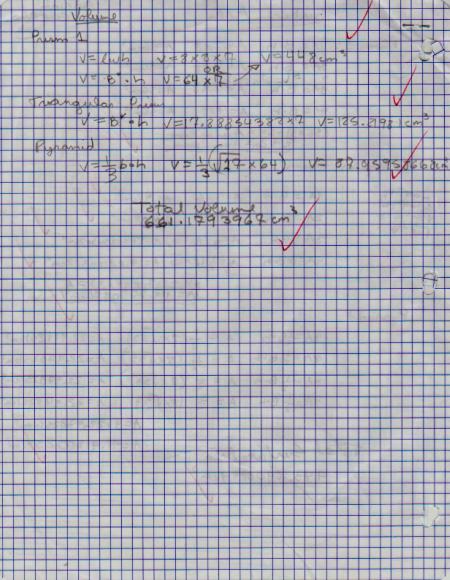
A reader asked me to post some samples of student calculations for the 3-D project. I had been meaning to all along, just didn't get around to doing it earlier because things have been so busy.

Anyway, here they are, on the eve of giving our printer/scanner away. :) I had full intention of scanning in an array of student work until I remembered halfway through the process that scanning is very tedious.

So here it is, what I managed to get done before my impatience took over. These are from regular Geometry kids.

Student #1:


Student #2 (in the same group as previous kid, but doing his calculations independently... they share only the grades for their constructed project and their 2-D nets):


Student #3 (totally separate group):


By the way, did I mention that it's trickier than I had thought for kids to build cones from scratch? Here's a sample 2-D net that one group used. They had to calculate the central angle using some proportional reasoning, in order to find the amount of arc length they want on the bigger circle, in order to create a lateral surface that perfectly fits around the base of the cone.


Not bad, eh? Truthfully, across the board the groups did very well. One group had an awesome hexagonal pyramid design/calculation (but I'm not posting it here because one partner copied calculations off of the other, so I ended up punishing both severely for plagiarism).

PS. I feel that I should take this opportunity to give a shoutout to my honors kids' beautiful 3-D projects. I could not bring myself to throw some of these projects out today while packing up my classroom, so I'm leaving some of them behind on the shelf in hopes that the next Geometry teacher will adopt them as classroom displays.

Tuesday, June 7, 2011

Money Matters Associated with International Move

I wanted to write down some moving logistics for people who might find themselves in similar shoes as us later. Moving after having lived somewhere for two years is entirely different from moving abroad the first time, because...
* Now you have a bank account that you get your salary directly deposited into, that you have to close before you leave the country (without butchering any direct deposits).

* If you want to wire any money to your Stateside accounts, you have to allot about a week to do that BEFORE you close your foreign accounts.

* You have presumably been contributing to a foreign social security system, presumably with matched contribution from your school and presumably it's some significant amount of money that you wish to get back at some point. It's not totally straight forward how this is done, because if you want the full amount back (including your school's full contribution up to your length of contract), I believe the standard operation is to start the refund process AFTER you leave the country, which means someone else than you will have to pick up that refund for you...

* In order to take care of some of these things smoothly, you may have to transfer your power of attorney onto someone else who will remain in the residence country after you leave. Obviously, you should choose someone that you can trust, but also the paperwork process can be a bit of a hassle and take up to a week.

* If, like me, you are moving to another foreign country afterwards, you should contact the school well in advance to figure out if there are temporary places to store your stuff. In my case, I've had to wire over some advance payment to my relocation agency in order to get a storage unit started for me (which, again, takes time and some follow-up energy).

* Did I mention that you cannot assume that you will be able to afford the moving costs?? Good thing Geoff and I don't have much stuff, because the estimates we got from two different moving companies for our ridiculously few items were both around $2000. I guess that depends on where you're shipping from and to, but the point is that you want to look into this stuff early so that you will have options. In our case, the only things we're shipping are my teaching supplies, in small boxes. Everything else we're going to squeeze into our two suitcases per person as when we arrived here.

...Anyway, all things considered, I'd say that our moving process is going swimmingly. My only regret is that I am an idiot and didn't go in time to a Salvadoran doctor to get my wisdom teeth removed while it's still dirt cheap. (The doc refused to do it since I'm flying out in under 2 weeks.) But, I am hopeful that perhaps it won't be too bad under the German insurance to take care of this little weisheitszahn problem. (My first German word!)

Sunday, June 5, 2011

Last Days in El Salvador

Now that our time in El Salvador is coming to an end, I wanted to count our blessings a bit before we move on to our next stop.

Things I will miss about El Salvador:
* yummy, cheesy pupusas
* incredibly warm people
* tropical climate
* how time seems to be suspended every time we go to the beach
* the loveliness of Spanish
* how El Salvador is almost untouched by tourists and English
* $15/hour massages and our $13/week maid
* living within walking distance to the school
* freedom from any test-prep pressure
* free round-trip annual tickets to the States
* having incredible teaching resources at the school and various support staff helping me set up labs for my classes
* the kids I taught last year, who still came back to me all the time this year for help and advice...
* The Head of our school is a great boss and someone whom I feel comfortable walking into the office of without appointments.

Things I will not miss:
* unreliable water, power, and sometimes internet
* giant rain-filled pot holes that they just don't bother fixing
* Salvadoran banks, which tend to prolong every process and make everything difficult to accomplish
* feeling unsafe at night or during the day in the boonies
* hearing people complain about stupid things while many other people in this country have literally nothing and NO opportunities!

Top 13 memories during our 2-year stay (I couldn't fit it into a neat list of 10):
* Pacaya - live-lava volcano in Guatemala where we roasted marshmellows on the lava stream
* Machu Picchu and Wainapicchu - sky-high Inca ruins in Peru
* Calafate - still growing glacier mass in Argentina
* Rio Celeste - natural bright blue river in Costa Rica, in the midst of a rain forest
* El Tabacon - labyrinth of luxurious hot springs in Costa Rica, channelled from natural volcanic springs
* Cerra Negra - "volcano boarding" in Nicaragua
* amazing snorkeling in Belize
* Tikal - Mayan ruins in the jungle of northern Guatemala
* Santa Ana, Izalco, Coatepeque - Salvadoran volcanos: one with a smoking green crater lake, one with bare rocky top, and one with a beautiful volcanic lake.
* Atitlan - giant and beautiful volcanic lake in Guatemala, complete with cliff-jumping!
* staying with a local family on an island in Panama (in a village with only huts and no sewage system) and then island hopping between untouched paradise islands
* a bunch of teachers going to the lake house of one of my students and doing lake sports and BBQing with their truly awesome family
* Almost getting robbed by a masked bandit in Guatemala at machete-point and driving off while screaming. (This is not a good memory, obviously, but it taught us a helluva lot about being safe. So, it's a very memorable experience.)

As the year wraps up (Geoff leaves in 7 days and I leave El Salvador 4 days after him), I am endlessly thankful for the experiences that we have had. Geoff and I always say this, but it's true -- we are some of the luckiest people, because we have jobs that we love, we are saving money and traveling at the same time, and we have each other to share this amazing experience with.

Summer (and Germany), here we come! :)

PS. I think the more Spanish I have learned, the worse an effect it has had on my ability to spell in English. Take "glacier" for example, it didn't immediately occur to me that I was spelling it "glaciar" like it is in Spanish, since when I visually checked the word, it looked very familar to me. And for the same reason, my natural inclination was to type "masage" (similar to masaje) instead of "massage"... Dangerous!

Friday, June 3, 2011

Unit Circle and Wave Functions Project - Part 3

Just to round it out a bit, I thought I'd finish writing about how I leveraged my students' understanding of basic sine and cosine functions and their relationships to circles, in order to get at some basic solving of simple trig equations. It bothers me that in the textbook we'd see exercises like:
1 + 3*sin(5x) = 2 and kids would be expected to solve the equations without ever knowing what it means.

It's simple:
Let's say you've got a point C rotating around a circle of radius 3. The center of the circle is at (0, 1) and the point starts rotating at the normal "3 o'clock" position, (3, 1) in this case because the radius is 3 units. The rate of rotation is 5 radians/sec and the point rotates counterclockwise. At what times during the first cycle will this point reach a height of exactly 2 units above the x-axis?

A kid who understands how sine and cosine functions relate to circles should be able to write the function f(t) = 3*sin(5t) + 1 based on the above description. And then, they should be able to say, "I want to solve for time given the height is 2, so I'm going to plug 2 into the left hand side of the equation. Thus, 2 = 3*sin(5t) + 1." And then and only then should this kid find the two time values t that correspond to this y value! My kids can sketch a unit circle and articulate that we have two solutions (within the first full rotation) because there are two points along the circle with that same height. And then they can justify using a sketched circle why you find one radian solution, and then the other one is just pi minus that first solution (each of which you then divide by 5 to go from radians traveled to time it takes, if you are moving 5 radians/sec).

We can also illustrate the use of other simple trig equations such as [sin(x)]^2 + [cos(x)]^2 = 1 the same way. Instead of giving our kids cos(x) = -0.9 and asking them to solve algebraically for all other 5 trig values without knowing what it all means, why don't we instead say...

You have a circle whose radius is 1 and its center is (0, 0). Point C starts rotating around this circle counterclockwise at (1, 0) and moves at the regular speed of 1 radian/sec. Where (x, y) will Point C be after 5 seconds? When point C reaches a horizontal location of 0.9 units to the left of the y-axis, how high or low will it be? Find all 6 trig ratios at those points.

What kids should be able to do (with a bit of practice) is to go from something like f(x) = -2cos(0.5x) + 8 and g(x) = -2sin(0.5x) - 3 to drawing a circle of radius 2, centered at (8, -3), with its rotation starting at (6, -3) and moving at 0.5 radians/sec counterclockwise. From there, given a description of a certain height OR horizontal location, kids should be able to choose the appropriate equation, substitute in the appropriate value in the appropriate place, solve, and explain in a simple sentence what the numbers mean. And then, they should be able to take those waves and graph the wave functions while explaining the transformations that occurred to the waves as a result of the transformations inside the circle... thereby showing a full and flexible understanding of sines and cosines.

...I'm a newbie Precalc teacher, but I feel strongly we cannot be teaching kids how to solve trig equations -- even the basic ones! -- without re-focusing on the meaning behind those sinusoidal functions. I'd love to see how other teachers can take this idea and apply it to more complex trig operations!!

PS. You know what's cool about kids playing around in GeoGebra? Some of them discovered for themselves that if you do C = (3cos(t), sin(t)), you end up with the point rotating around an ellipse (because the amplitudes are imbalanced horizontally and vertically). How are textbooks supposed to replace that type of discovery??

Addendum June 4, 2011: Here is a sample worksheet I used in my class that gets at some of these concepts in an integrated manner.


If you want the full file, you can grab it here and let me know how it goes. :)

Friday, May 27, 2011

Unit Circle and Wave Functions Project - Part 2

(This is a continuation of the previous post, talking about a previous GeoGebra project we did in Precalc.) Here are some samples of circles and associated waves that students did from scratch in GeoGebra: Part 1, where kids had to create a slowly counterclockwise rotating point along the unit circle; Part 2, where they had to make the circular path bigger; and Part 3, where they had to make the circle smaller and make the point rotate clockwise.

Here are some excerpts of student explanations as they reflect on how coefficients affect wave graphs and circular rotations. I pasted a different student response here for each question so you can read a variety of student "voices" as they attempt to articulate the concepts.

Student A - Question #1 asks the student to analyze the effects of coefficients on cosine wave and on the circle.

1. For the function f(x)=A*cos(Bx), A determines the radius of the circle and it therefore changes the amplitude of the cosine graph. In the circle, if A is greater than 1, for example 2, then the radius would be bigger because it would be 2 and the wave would be taller because it would go from 2 to -2. If it is less than 1, like 0.5, then the radius would be 0.5 and the wave amplitude would be smaller because it would go from 0.5 to -0.5. If the A happens to be negative then the graph would flip across the x-axis. When you flip the wave graph vertically along the x-axis the graph would start at -1 instead of 1. A horizontal flip across the y-axis wouldn’t matter for cosine.

If B is greater than 1 then the point takes less time to make a period because it is moving faster. For example, if B would be 2 then you would complete 2 periods in the time it normally takes to make 1. It B is less than 1, i.e.: 0.5, you are slower, thus it takes you twice the time to make a period. For B in the cosine wave, it doesn’t matter if it is negative or positive because it will be the same x-value regardless if the point in the circle is moving clockwise or counterclockwise.

Student B - Question #2 asks the student to analyze the effects of coefficients on sine wave and on the circle. Here, some of the explanations may duplicate part of their answer to #1, but I'm looking for the student to articulate that the sine wave flips if you make B negative, because it matters greatly whether your point rotating around the circle is going clockwise or counterclockwise, if you're tracking its height over time. This kid's response isn't perfect, but she's getting most of the ideas.

2. g(x)=A*sin(Bx)

A affects the amplitude of the graph and makes the circle smaller or larger. Say A=4 will make the graph have its y-maximum at 4 and y-minimum at -4; the circle will have a radius of 4. Say A=0.5 will make the graph have its y-maximum at 0.5 and y-minimum at -0.5; the circle will have a radius of 0.5.
This means that the point along the circle will have more or less height over a certain amount of time.

B affects the wavelength distance and the speed a point moves along a circle. Say B=4 will make the wavelength shorter because it will travel more distance over a certain amount of time. B=4 will make the point in a graph move faster. B=0.5 will make the graph have a longer wavelength. B=0.5 will make a point in a graph travel much slower.
This means that the point along the circle will travel in a slower or faster pace the height in a certain amount of time.

Sine is the height of the point along the circle over time.
*Signs of B do affect the shape of the sine graph because it is not symmetrical. This means that a point in the opposite side of another point, won’t have the same height.

Student C - The next two questions, #3 and #4, are fairly straight forward. The kids need to explain how you could manipulate sine and cosine functions in order to make the circle bigger, smaller, or to turn the rotational direction around.
3. In order for you to create either a larger or smaller circle you have to change the number in front of the sine or cosine formula. If you want the circle to be bigger the number in front has to be greater than 1 and if you want the circle to be smaller the number in front has to be less than 1. For example for a circle to be smaller the number has to be less than 1 such as C=(0.25cos(t), 0.25sin(t)). This will make the circle be smaller and have a radius of 0.25. On the other hand if you want the circle to become larger the value has to be replaced by a number greater than 1 such as C=(2cos(t), 2sin(t)). This will make the circle larger by augmenting its radius to 2.

4. In order for the point of the circle to rotate in a clockwise rotation you have to change the formula by adding a (-) sign before the (t) value. An example to make the rotation clockwise is C=(cos(-t),sin(-t)).

Student D - Questions 5 and 6 ask the student to analyze a given sine or cosine equation to tell me about the circular motion that is (partially) described. I'm looking for them to describe the size of the circle, its speed, the direction of rotation along the circle, and the (x, y) point along the circle where the point starts rotating at 0 seconds.

5. m(x) = 2sin(-5x) models a circle with a radius of 2. Point C is moving in a clockwise direction, meaning that it first goes down. It’s going 5 times faster than normal, which would be 5 radians/second. Point C starts at (2,0).

Student E - See above. This kid should have shown more work or explained how they got to their starting point (x, y).
6. What behavior is modeled by n(x)= 0.5 cos(x+3)? Include in your description the size of the circle, the speed, the direction and the starting location of the point that is moving along the circle.

Size: diameter of 1 (radius of 0.5)
Speed: Starts 3 seconds “before”- has a “head start”
Direction: counterclockwise
Starting point on the circle: (0.5, 0.7056)

Student F - For #7, the students needed to try to create a point that's rotating around a circle NOT centered at (0, 0).
7. [In order to create a circle whose center is not at (0, 0)...] I plugged in the formula, C = (cos(t)+3, sin(t)+3) and the center of the circle is (3,3). Sine would be f(x) = sin(x)+3 and cosine would be f(x) = cos(x)+3

This activity was very helpful to our later discussions on how to graph sine and cosine graphs by hand and how to set up and solve for simple trig equations, and what it all means. Stay tuned for more follow-up worksheets and discussions! :)