A short while back, I set out to create a GeoGebra project that would help my juniors in Precalculus understand sine and cosine functions. I remembered that over the summer when I was playing with GeoGebra, I had discovered that if you define a point like C = (1, 0), GeoGebra sets the point down statically, but if you first define a slider variable (such as t) and then you define point C using simple trig as C = (cos(t), sin(t)), then GeoGebra creates a point that rotates in a circular path around the origin as you drag to change the value of t along your slider. I remember feeling amazed by this, even though obviously it made total mathematical sense.
So, I sat down in May to create a multi-day project for my Precalc kids, to help the meaning of sine and cosine sink in. It turned out to be pretty darn cool as a learning tool. In the project, the kids had to create several circular points of different radii and rotational speeds (we assumed t meant seconds, and C=(cos(t), sin(t)) thus meant that your point is rotating along a circle at "regular" speed, 1 radian/sec) and directions (clockwise vs. counterclockwise). For each rotating point, they had to create corresponding sine and cosine waves each with a point that traces along the wave as you drag t. This allowed them to verify visually/kinesthetically that that sine is always positive when the circular point is above the x-axis, and cosine is always positive when the circular point is to the right of the y-axis. And then they had to answer a bunch of questions to fully show me that they understand what circular motion is being modeled by
f(x) = 3sin(-0.5x), or g(x) = 0.5cos(x + 3), and WHY and HOW that circular motion impacts the shape of the wave graph.
Anyway. I've got to finish writing about this later. So, consider this the Episode 1 of the unit circle project. You can read about the project specs here. The really cool thing is that my kids submitted their writeup and GGB project files digitally, and so I will get to really show you the results of their understanding.
But, that will come. A bit later. That's Episode 2. Maybe Episode 3 I'll go into then how this feeds into their understanding of solving trig equations. Stay tuned.
Wednesday, May 25, 2011

Monday, May 23, 2011
Hot Off the Press
Our Honors Geometry magazines Issue 1 and Issue 2!
Stay tuned for the Precalc unit circle GeoGebra projects.
In other news, we sold our car today. It feels... glorious. I've got about 3 weeks left in San Salvador. OMG I love the feeling on the eve of a big move. It makes having only intermittent water supply seem almost bearable. :)
Stay tuned for the Precalc unit circle GeoGebra projects.
In other news, we sold our car today. It feels... glorious. I've got about 3 weeks left in San Salvador. OMG I love the feeling on the eve of a big move. It makes having only intermittent water supply seem almost bearable. :)
Wednesday, May 18, 2011
3-D project photos!
Check out the 3-D objects my regular Geometry kids designed, drew 2-D nets for, calculated surface area/volumes for, and then finally built:
I love them! :)
The year's winding down. I feel GREAT. We're definitely ending on a good note. Kids are doing some cool things across all of my classes these days. Life's been busy, but when I get a chance to catch up I'll write more about other projects besides this one. Ciao!
I love them! :)
The year's winding down. I feel GREAT. We're definitely ending on a good note. Kids are doing some cool things across all of my classes these days. Life's been busy, but when I get a chance to catch up I'll write more about other projects besides this one. Ciao!
Saturday, May 14, 2011
Success!
The 3-D project turned out to be the coolest project I've done all year with my regular kids. The constructions looked amazing and I think I actually looked over ALL of their volume and surface area results before they submitted their work on Friday, so their calculation grades should be fairly high as well. It was really amazing -- the kids were super motivated because they thought designing/measuring nets and then building things out of a net was ridiculously fun, and they really understood when I said that surface area does not include any two surfaces that are glued together (ie. the bottom of a pyramid, if the pyramid is attached to another prism, and you'd also have to subtract that pyramid base area from the top surface of the prism as well). And they had to really understand slant height versus real height of a pyramid, in order to correctly calculate both surface area and volume of the pyramids. Some groups chose to make hexagonal prisms and hexagonal pyramids, which made their calculations even more exciting/challenging! A bunch of groups also built 3-D concavities into their solid, which added to their overall surface area and took away from their overall volumes.
It was really, REALLY great. On Friday in class I let the kids just have a fun day decorating their composite solids. Meanwhile, I went around and did a final check of their volumes and surface areas to make sure they understood all the big concepts of the project.
After school, some 11th-graders who came by to turn stuff in were amazed that the projects piled on my desk were made by regular 9th-graders. :) Yeah!!!
For sure, pictures will come. I can't decide if I should be taking pictures of their beautifully decorated solids or scanning in their beautiful perspective drawings and 2-D nets and calculations. This week has been CRAZY but oh-so-worth-it!!
PS. The geometric magazine is also coming along smoothly. I think in about a week I'll have a polished PDF I can post to share with you all! This entire week has been crazy from reading their gazillion drafts and offering detailed feedback daily, while managing other projects across every class. I haven't touched Google Reader all week; that's how bad it was. But I think I am seeing the light at the end of the tunnel, and their final drafts are quite lovely! :)
Tuesday, May 10, 2011
3-D Object Project
Last year, when I taught 3-D topics at the end of the year, we: watched Flatland (which we did again this year... the kids LOVED the movie and were bubbling with opinions about the existence of a 4th dimension); did some awesome computer investigations (which we are still going to do this year); and we also did a bunch of textbook practices involving volumes and surface areas of composite 3-D solids. This year, I scrapped the in-class algebra practices, am assigning just a few problems as Do Nows and daily homework, and instead we are doing an in-class project where kids design and build their own composite solids, for which they'd have to calculate the volume, surface area, and draw related nets.


My regular kids have already: learned how to keep track of surfaces (in computing surface areas); figured out how to find the height of a cone or pyramid given its slant height; reviewed how to calculate volumes and surface areas of a prism/cylinder or a pyramid/cone. In terms of their projects, most of the groups in my regular Geometry classes have gotten their 3-D designs and dimensions and nets with dimensions approved by me, and some groups are starting to cut out the nets to create the 3-D shapes.
I am excited! The regular projects are on track to be finished by Friday. (Honors kids will have a few extra days, since I want their efforts this week to be focused on polishing their Geometry magazine articles.) Their designs look pretty awesome and are all very different; the kids are practically tripping over themselves with excitement over this last project. Pictures to come!

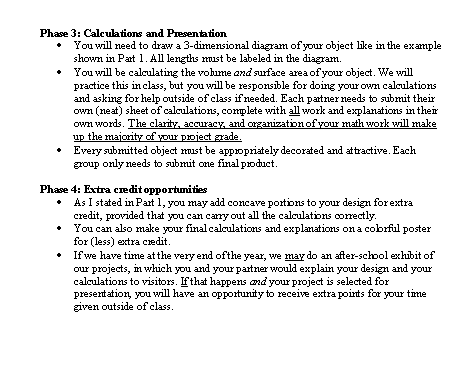
My regular kids have already: learned how to keep track of surfaces (in computing surface areas); figured out how to find the height of a cone or pyramid given its slant height; reviewed how to calculate volumes and surface areas of a prism/cylinder or a pyramid/cone. In terms of their projects, most of the groups in my regular Geometry classes have gotten their 3-D designs and dimensions and nets with dimensions approved by me, and some groups are starting to cut out the nets to create the 3-D shapes.
I am excited! The regular projects are on track to be finished by Friday. (Honors kids will have a few extra days, since I want their efforts this week to be focused on polishing their Geometry magazine articles.) Their designs look pretty awesome and are all very different; the kids are practically tripping over themselves with excitement over this last project. Pictures to come!
Friday, May 6, 2011
Some Old Action Shots
My friend, the head librarian at the school, emailed me some photos today from a while ago when my kids were testing out their centroids in the library by trying to balance their triangles on top of a sharpened pencil. Cute!! (We went to the library because there we could sit in the coolness of the AC and not have the ceiling fans blow the kids' triangles all over the place. Plus, the library has flat tables, which are good for trying to balance things on.)
Here are a couple of good pictures. The kids were so intent on making their little triangles balance! They have to be absolutely serious and have still hands and their centroid has to be absolutely PERFECT for it to happen. It's a really fun activity, last year and this year. (Last year, as a fluke, I was able to balance my own triangle on a sharpened pencil held in my own shaky hand, while talking to the class, for about 15 full seconds! At some point I even took a couple of steps, and the triangle was still hanging on. They thought I was their hero.)


Here are a couple of good pictures. The kids were so intent on making their little triangles balance! They have to be absolutely serious and have still hands and their centroid has to be absolutely PERFECT for it to happen. It's a really fun activity, last year and this year. (Last year, as a fluke, I was able to balance my own triangle on a sharpened pencil held in my own shaky hand, while talking to the class, for about 15 full seconds! At some point I even took a couple of steps, and the triangle was still hanging on. They thought I was their hero.)


Monday, May 2, 2011
Square Root Fun
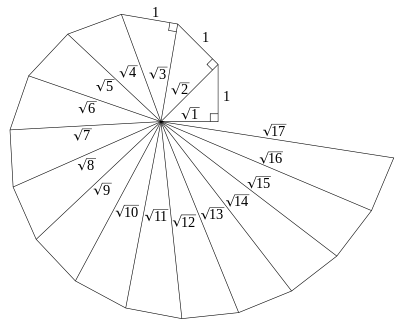
Today and tomorrow, we're spending Geometry class time exploring the geometric nature of square roots. Well, that's a loose description, anyway. It's a transition topic and something I loved from last year, so we're doing it.
Today my kids constructed using protractors and rulers a Spiral of Theodorus (see above). They started with the smallest right triangle measuring 1cm in each leg. In the margins they showed all the Pythagorean math work, which helped them practice a gazillion times how square root and square cancel each other out, and helped them see why $\sqrt{5}^2 + 1^2 = c^2$ means that $c = \sqrt{6}$, for example.
Then, we simplified things like $\sqrt{9}$ and $\sqrt{16}$ to verify with a ruler that our integer lengths matched what we saw on the ruler. And we simplified expressions like $\sqrt{12} = 2\sqrt{3}$ to make sure that we were able to compare the two lengths (as measured with rulers) and verify one length to be double the other. All in all, it was a productive, visual, and relatively pressure-free practice of their arithmetic skills without using the calculator.
Then, I took the opportunity to quickly explain visually what square root means and why it's not correct to simplify as such: $\sqrt{a^2 + b^2} = a + b$. I told the kids that it's one of those common mistakes in algebra that you can avoid if you have a geometric understanding of what's going on.
I drew this on the board and we discussed it briefly.*

It was immediately evident to the kids that you can't simplify as described above, because the area you have is "too small" to be broken up nicely into two sides of lengths $a + b$ each. I re-emphasized that if you have a geometric understanding, it helps you out a lot of times with algebraic concepts!
I'm excited about tomorrow! I will be doing more square root investigation with my kids... this time on Geoboards! My worksheet is based off of this lovely activity, but I re-worded/scaffolded it a bit more and added a few questions. I am, in fact, getting videotaped for this lesson, which makes me OH SUPER NERVOUS!!
Anyway, I am cherishing these last weeks with my kiddies. June is coming way too fast. I am running out of time to play Geometry with them! :(
*PS. I guess I wasn't being totally accurate in the second diagram. Should have used abs(a) as the square root value. Oops.
Subscribe to:
Posts (Atom)