I am a big fan of estimation, probably because I am lazy. I think that most percent problems (obviously not all) can be done with just basic numerical / proportional reasoning.
For example, my Grade 7s are pretty darned good by now at doing something like "find 15% of 6.4". They can articulate that 10% of 6.4 is 0.64, and then half of that is 5% = 0.32, so 15% is 0.64 + 0.32 = 0.96 . They can also do something like "find 12% of 88" by reasoning that 10% is 8.8, and then 1% is 0.88, so 12% is 8.8 + 0.88 + 0.88 = 8.8 + 1.76 = 10.56 . Recently I looked over the big semester test that we had given last year in December, and realized that we won't have time this year before the semester exam to cover enough of proportional reasoning to do a problem like "9 is 15% of what number?" using a setup of proportions and of solving by cross multiplication. (We've only just started proportional reasoning this week.) So, today I just decided to throw up some of those types of questions on the board as the Do Now, and the kids were surprisingly clever at figuring it out! One of them said, "It's not that hard. It's like playing Math Detective."
"3 is 10% of what number?" --> This was the first "backwards" type of question I had put on the board, and the kids thought it was quite easy. You're just multipling by 10 times to get to 100%, which is 30.
"12 is 15% of what number?" --> Some kids naturally, intuitively, broke it down to 5% being 4, which is a "nice" percentage to have/know because then you know that 10% is 8, and therefore 100% is 80.
"6 is 2% of what number?" --> To do this, they were also clever. Some did it as 1% is 3, so 100% must be 300 if you know that one out of the 100 parts is 3. One kid immediately thought that you can scale both values up by 50 times in order to reach 100%, to save us from doing two steps of work.
I really liked these discussions, because I think -- in lack of a formal proportional setup -- this is the most intuitive way of approaching percentages, in my mind. It reinforces the meaning of percents and frees kids from fear of these fairly basic everyday concepts.
We discussed briefly why this is proportional reasoning. It tied very nicely to the word problems we did today on proportions, but I am not going to touch cross multiplication until January. (It's just too much, too soon for many of them, and they have already worked very hard to fill in the gaps this semester.)
So, go seventh-graders! I feel very hopeful that, despite my concerns about many of them at the start of the year, the majority of the class is nearly caught up to where they ought to be at this time of the year.
Thursday, December 6, 2012

Saturday, December 1, 2012
Thinking About Elementary Math
Recently I've had some questions come my way about what the younger kids need to be able to do in order to be successful in the future years. I am no expert, but I am very interested in getting a discussion started about this from a Middle School perspective.
Specifically:
Specifically:
- I think in grades 1 - 4, the most important skills to develop are obviously basic (up to two-digit) addition, subtraction, and "nice" multiplication and division using the times table. For the young kids, manipulatives are very important in order for them to understand the meaning of these operations.
- In Germany (and probably other places as well), they use a triangular diagram to teach the idea of inverse operations in elementary school. For example, the diagram below reinforces that 60, the total, can be divided by 5 to get 12, or divided by 12 to get 5. The two bottom operations multiply to form 60. The neat thing about this triangle is that it extends into algebraic relationships such as D = rt, D/r = t, or D/t = r. My lawyer friend who grew up in Israel told me that this is how they learned basic operations in school.

- I think that by grade 5, kids should be able to do addition from left to right, in order to build up their estimation skills. For example, adding 638 + 290, yo can look from left to right to get 800... And then when you look just one digit ahead, you can already estimate that 9+3 is bigger than 10, so the result is actually 900 something. 928, to be exact, if you keep adding from left to right, peeking just one digit ahead each time. The nice about this is that even if kids only quickly looked at two numbers being added, they can already estimate the sum reasonably.
- I think that by grade 5, kids should be able to multiplication of two-digit by one-digit numbers in their heads. Teaching kids to break down (82 times 6) into 80 times 6, plus 2 times 6, reinforces two things: placement values and the idea of distributive property within arithmetic. It makes introducing the algebraic distributive property in middle-school a breeze, if kids already have seen it in action.
- Sometime in grade 5 or grade 6, when kids start to learn conversion from decimals into fractions, this should be done using their proper naming of numbers. 5.6 is read properly as "five and six-tenths", and the way we write that in fractions is immediately 5 6/10. Going backwards, they should be able to do the same, at least for base-ten fractions. 3 9/100, is read as "three and nine-hundredths", which writes as 3.09 in decimals.
- There are a lot of resources out there for fractions already, but I think that the most important representation is the number line and the comparison of numbers. To find a fraction of any number, the kids need to know that 1/n is one out of n equal pieces, so k/n just means that size, multiplied by k. I think the concept behind fractions is so so so SO important, so it should always be done in context.
- Dividing by simple fractions can be done similarly using reasoning. I teach my middle-schoolers how to intuitively divide 5 by 1/3 by first asking them what is 1 divided by 1/3. We draw diagrams until everyone can see why it is 3 (and I use language like, "how many times does 1/3 fit into 1?"). And then I ask them what is 5 divided by 1/3. ("How many times does 1/3 fit into 5?") The language that you use with fractions, I think, has an immediate impact on the children's understanding of the operations. Of course, this does not bypass the need to show them the manipulation of fractions in division, but it helps to add meaning to the otherwise rote/abstract operations.
- By the way, the triangle (shown above) can be used to reinforce why 5 divided by 1/3 is 15, and why 5 divided by 15 is 1/3. One of Geoff's friends has a good analogy to cutting potatoes in order to illustrate this. (You can cut 5 potatoes into 15 groups of 1/3 potatoes each, or if you already knew that you wanted to make 1/3 potatoes the size of each group, you can make 15 groups.)
- I recently wrote a short email outlining my recommendations for decimal division in Grade 6, so I'll just paste it here. "I think
for decimal division, kids should be able to reason through
step-by-step, starting with normal division. For example, to teach
7.2/6, I’d start first
with 72/6 = 12, and then ask kids what they think 7.2/6 will be, and
then ask them what 7.2/0.6 will be, and then 7.2/0.06, etc. You can use
it to introduce this idea of ratios between numbers. Have them practice
this on other decimal pairs instead of teaching
the rote “moving it over this many times” trick.
Also, this is a useful trick: 700000/35000 = 700/35 = 20. Or 840/120 = 84/12 = 42/6 = 7. They should always reduce before division, if they can. It’ll make their lives much, much easier down the road to not have to divide with so many digits involved.Another thing is that, I don’t know how familiar the Grade 6 kids already are with fractions, but I think that if the division is very messy, the kids should stop after the unit digit and just write the rest as a fraction. The most important thing from Grade 7 on is that they can estimate decimals, such as to know that 11/7 is between 1 and 2, just past 1.5 because 11/7 = 1 4/7. They don’t need to really get that it is 1.57142857142857142857142857142857 since we all have calculators…."What do you think? Disagreements? Something I missed? I would love to hear what all the MS teachers have to say about what makes a child successful coming into MS.
Wednesday, November 28, 2012
A Pause in the Moment
I really like this time of the year, because the kids are very motivated and I know all of them well enough to pinpoint their strengths and weaknesses, and I have worked with them long enough to see a pattern in their learning and to see if they are growing in their efforts, responsibility, and habits of mind.
One thing I am trying this year (sort of organically) is to have all assignments be a dialogue with the students. They turn the assignments in, I look at them, give them back with written comments, and if the student's work isn't up to par, then the student knows that they need to re-do it (because I say it to them, leaving no assumptions). I think this back-and-forth dialogue is a more natural way of learning, and as a result I am a bit more lax on the deadlines. Unless a kid's work is more than a couple of weeks late, it matters more to me that it's done well than it is done absolutely on time. And it also helps to instill a culture of quality over quantity of work.
---------
We have an intern in our department this semester, and talking to her is bringing back all kinds of memories of my own first year of teaching! (All the hectic schedule, the stress, that feeling of momentary panic when you're standing in front of the room and kids won't listen, etc.) She's great though, definitely much better/firmer than I was as a first-year teacher. She's also multi-talented, totally certified to teach math, science, and German all at once. I'm still working on my one semi-professional qualification of teaching math...
Besides that, I think our department is finally, finally at a smooth-sailing pace. We've finally recovered from the shock of the start of the year, when everything was constantly backlogged. It only took us 4 months to get to this place. I can only say that the next year will be better, because I'll already know my way through the start of the year, and I can prepare for it better. Being a department chair is definitely not easy, but I think people have gradually warmed up to me in the last 4 months (and I have gradually gotten used to the responsibilities). By that, I mean now they don't bolt out the door at 4:30pm at the end of the meeting. They actually linger until we're done with business... which is a definite sign of something good, however small. I think I have a good relationship with everyone in the department, which really, really helps to smooth things over when issues arise. I cannot wait to see what the second half of the year will bring!
Sunday, November 25, 2012
Late Autumn in Berlin
Time for a bit of general Berlin updates! (Math teachers who are not interested in this: Sorry, go ahead and move along in your GReader.)
October and November have been fairly busy months for us! First, the Jersey boys came to visit during Oktoberfest. It was a very rowdy good time (we had rented a house in the heart of Munich), and Geoff got all kinds of nostalgic thinking about how this might be the last time -- minus our wedding -- that they could have crazy, random experiences like this, since all the boys are nearing that age when they are thinking about settling down for good...

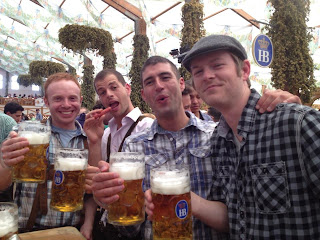
By the way, I don't know if you have ever been to Oktoberfest, but there they build these huge tents (like the one you see below) for only the month of that festival. It's incredibly hard to get in on Fridays and Saturday nights to one of the big tents, so we had to bribe the bouncers. Once you get in, the tent gets more and more crowded and crazier and crazier as the day rolls on...
While the boys were still here in Germany, we rented a Bier Bike, which is a mobile bar that you can pedal around Berlin while singing out loud and waving at people. We blasted Queen's Bicycle Race several times during the course of two hours on the bike, and we kept going afterwards to a hipster restaurant called White Trash, followed by karaoke until about 3am. It's very Berlin to have a bunch of random experiences all in one day, because this city is just organic and crazy!

Soon after the boys left, I heard via the grapevine that the Berlin Light Show was about to come to an end, and that it was cool to see the light show from the top of the Berlin Reichstag (Congress Hall). I didn't even know that you could make an appointment to visit the Reichstag at night! We had only been there once during the day. So, on a Sunday night in late October, we walked around Berlin to enjoy the light festivities on the famous monuments, and then went up the Reichstag.


Halloween was a bit quiet this year. On the actual day of Halloween itself, we had German class, so I went to class as normal and only wore my cat ears to be festive. My non-American classmates thought it was funny that I would celebrate this type of holiday still in costume. On the way back, I was impressed to see a holiday graffiti at the subway station, since it was quite a production and you know graffiti artists are seriously prosecuted by the subway officials. Later during the weekend, we went to a party where Geoff dressed up as the recycling goddess (he made a hula hoop skirt out of toilet paper rolls that we had collected for over 6 months, and also he made a busty bikini top out of cut-out juice containers), and I was dressed as eine Katz im Sack zu verkaufen, which means I was a cat inside a trash bag, with a for-sale sign taped to the bag. In German, "buying a cat in a bag" means to purchase something (such as a used car or an old building) without having seen it, so you don't really know how it's going to behave afterwards. In other words, I was playing off a German pun, but Germans don't really get why Americans would dress up as non-scary things for Halloween, so it was a fairly obscure costume...

Then, there was the Sparkle Army party this year! The Sparkle Army is an annual party at our favorite karaoke place, where if you dress up in sparkles then you can get in for free. We have some friends who have been going every year for about 5 or 6 years (since the inception of this idea). The slogan of the party is, amazingly, "More is more!" They really want to spread the word of sparkle. Last year we went to the party, but we were pretty last-minute about the preparations. This year, since I had coincidentally run into the Sparkle Army girls while they were shopping for supplies a weekend in advance, I went ahead and made advance preparations. We ended up bringing 20 of our people to the party. It was a blast!!


To give you just a small taste of why this party is awesome, here was actually some random guy (not one of our friends) with an absolutely awesome outfit. He even had slippers with glitter bulbs glued on, and there were stuffed animals sewn onto his pink tutu. Faaaaan-freakin-tastic!

whew. That's all the fall updates for now. December will get its own story, when it's time... My friend comes to visit this Friday, to enjoy Christmas markets in Berlin with us. I have planned already a Christmas market crawl -- in Santa Claus outfits (a la Santa Convention style, like you can find in some major cities in the States). I can't wait! Our cheap Santa costumes will get delivered on Wednesday, and we bought the most hilarious-looking ones with a funny-looking shoulder cape... Let the Christmas season begin!
October and November have been fairly busy months for us! First, the Jersey boys came to visit during Oktoberfest. It was a very rowdy good time (we had rented a house in the heart of Munich), and Geoff got all kinds of nostalgic thinking about how this might be the last time -- minus our wedding -- that they could have crazy, random experiences like this, since all the boys are nearing that age when they are thinking about settling down for good...

By the way, I don't know if you have ever been to Oktoberfest, but there they build these huge tents (like the one you see below) for only the month of that festival. It's incredibly hard to get in on Fridays and Saturday nights to one of the big tents, so we had to bribe the bouncers. Once you get in, the tent gets more and more crowded and crazier and crazier as the day rolls on...

While the boys were still here in Germany, we rented a Bier Bike, which is a mobile bar that you can pedal around Berlin while singing out loud and waving at people. We blasted Queen's Bicycle Race several times during the course of two hours on the bike, and we kept going afterwards to a hipster restaurant called White Trash, followed by karaoke until about 3am. It's very Berlin to have a bunch of random experiences all in one day, because this city is just organic and crazy!


Halloween was a bit quiet this year. On the actual day of Halloween itself, we had German class, so I went to class as normal and only wore my cat ears to be festive. My non-American classmates thought it was funny that I would celebrate this type of holiday still in costume. On the way back, I was impressed to see a holiday graffiti at the subway station, since it was quite a production and you know graffiti artists are seriously prosecuted by the subway officials. Later during the weekend, we went to a party where Geoff dressed up as the recycling goddess (he made a hula hoop skirt out of toilet paper rolls that we had collected for over 6 months, and also he made a busty bikini top out of cut-out juice containers), and I was dressed as eine Katz im Sack zu verkaufen, which means I was a cat inside a trash bag, with a for-sale sign taped to the bag. In German, "buying a cat in a bag" means to purchase something (such as a used car or an old building) without having seen it, so you don't really know how it's going to behave afterwards. In other words, I was playing off a German pun, but Germans don't really get why Americans would dress up as non-scary things for Halloween, so it was a fairly obscure costume...

Then, there was the Sparkle Army party this year! The Sparkle Army is an annual party at our favorite karaoke place, where if you dress up in sparkles then you can get in for free. We have some friends who have been going every year for about 5 or 6 years (since the inception of this idea). The slogan of the party is, amazingly, "More is more!" They really want to spread the word of sparkle. Last year we went to the party, but we were pretty last-minute about the preparations. This year, since I had coincidentally run into the Sparkle Army girls while they were shopping for supplies a weekend in advance, I went ahead and made advance preparations. We ended up bringing 20 of our people to the party. It was a blast!!


To give you just a small taste of why this party is awesome, here was actually some random guy (not one of our friends) with an absolutely awesome outfit. He even had slippers with glitter bulbs glued on, and there were stuffed animals sewn onto his pink tutu. Faaaaan-freakin-tastic!

Saturday, November 24, 2012
Visualizing Complex Operations
I frequently feel sad that complex numbers are not part of the IB SL curriculum. During the time when I taught Algebra 2, it was always my favorite topic to connect algebra, geometry, and the history of numbers all at once.
Here is one cute activity I used to give to my students to illustrate the relationship between complex number operations and coordinate transformations. I recently gave it off-handedly to a student at our school, who was very intrigued by this, so I thought I'd share with those of you who still teach this topic. I think this activity is very eye-opening for the students and very visual, and it gives the various algebra operations a more concrete meaning / some motivation.
I vaguely remember that I had written about this a long time ago, but here I am posting it again since I cannot find the old post. (oops. Lost in the WWW, I guess.)
A Presentation with Optional Paths
I have been piecewise putting together a presentation I will be doing in the early spring at a conference called AGIS (for German international schools). I'm pretty nervous since it'll be the first time that I will be doing a presentation at a conference! My only previous presentation experiences were when I did a PD to my own department back in El Salvador, on utilizing web resources, and when I quickly presented something at PCMI 2011 for what I did with GeoGebra and unit circles. Both of those were quite informal, I think, compared to speaking at a conference... So, I've given myself plenty of head start to think carefully about the content and presentation format for the talk in the spring. As a presentation newbie, I am nervous about not knowing who my audience will be. As a teacher who tends to lecture minimally in the classroom, I am also concerned about audience engagement as a whole when I speak to them one-sidedly for a stretch of time.
This presentation that I am preparing will be on math projects as a tool for self-differentiation. One thing I decided to do for this presentation is to not assume that all teachers are very experienced with projects, OR that they're completely inexperienced. So, my presentation will start by laying the foundation for why I think math projects are beneficial for students, just to establish a common ground with everyone. And then we go into pivot points, where I'll poll the audience quickly to find out which topics they would like me to spend the most amount of time speaking about. I was inspired by the idea that within powerpoint you can have hyperlinks to other parts of the powerpoint (eg. those Jeopardy-format powerpoints), so depending on their interest, we can click through only certain math projects to discuss them in more details and to spend some more time discussing general project structures, or to click through all of the projects and discuss actual content rather than format and framework of projects.
Here is the powerpoint I've pulled together so far. Please check it out -- using actual slideshow mode -- and give me feedback! Once you see the rounded boxes, you need to click inside the boxes in order to navigate forwards and backwards... (I used the boxes in order to avoid having ugly underlined hyperlinks everywhere.) Not all of the projects are mine, and I haven't filled all the slides in with pictures yet, but I am excited about the overall idea of a presentation that self-adjusts in real-time to the responses and vibes from the audience.
Addendum: I have revised my powerpoint to make it less verbose... Now I think it's 90 or 95% finished! Check it out and keep those suggestions coming! Thanks!!
Saturday, November 17, 2012
Teaching Number Definitions Meaningfully
As a kid, I was never good with mathematical terms. I was always doodling in math class and only picked up vocabulary words osmotically (which also meant not so effectively). As a teacher, I have tried to make vocab instruction more meaningful for kids.
Recently, in Grade 8, we started talking about inequalities for the first time. I started off the discussion by asking kids to give me some examples of equalities, and we wrote them on the board. After a few minutes, we started to list examples of inequalities and I went over why in math, saying -5 is less than -2 is a bit more precise/less confusing than saying -5 is smaller than -2.
Then, I asked the kids to come up with some example numbers that can satisfy the inequality
x + 2 < 15 . The kids started to list numbers, and after a few minutes I asked them for what they wrote down, and in the context of this we discussed number types. I explained to them that I think generally, in life, when you want to brainstorm options in your head, you don't want to keep listing the same types of objects over and over again, because in doing so you are limiting your vision of what is possible. The examples that the first kid gave me were {1, 2, 3, ..... , 12} and the examples that the second kid gave me were {-1, -2, -3, -100}
I drew on the board this diagram and said that "a long time ago, when cave people started counting sticks on the ground, they came up with numbers like 1, 2, 3, 4... These were called natural numbers.* Then eventually they came up with one more number to add to that set, and they called it whole numbers. Can you guess what that new number was?"

After kids enthusiastically guessed zero, they were starting to understand this diagram representation of a subset and were beginning to appreciate the historical development of numbers. Then, I added another layer of negative numbers and asked them what that is called when we started at some point to include/consider negative numbers as well.
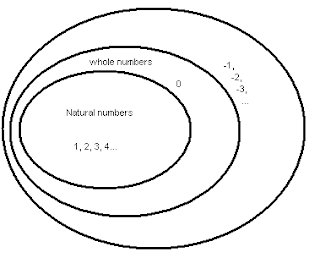 They figured out that it was called integers. Great!
Then, I asked them what types of numbers they still know / have learned that we haven't named yet. They gave examples of decimals and fractions, and we added them to this picture.
 In the end, we went back to the original topic at hand of finding example numbers that satisfy the inequality x + 2 < 15, and this time they were much better equipped to list a variety of examples and to discuss the full range of (non-discrete) solutions, which then led to the discussion of shading the solutions on the number line, and why we need the open circle rather than the closed circle sometimes.
I find this to be a more natural way to teach number types. Another time when I have done this was in teaching 9th-graders how to think of possible counterexamples that might disprove a math statement. If in their heads they are only considering a single type of example, then they're not being effective and thorough in their consideration of possibilities. As a kid, I would have appreciated this type of instruction of categorical types, followed immediately by application of its usefulness, and it would have probably helped me remember the names better. So, for me as a teacher, I always think it is important that I don't introduce the number definitions purely in isolation just because it's part of section 1.1 in the textbook. In the end, our teaching of these numerical categories should be explicitly supporting the kids' thinking, rather than just to add to the volume of disconnected rote knowledge in their heads...
*Note: By the way, I prefer this definition of natural numbers, even though I know that mathematicians don't all agree. Some refer to zero as part of the natural number set.
Recently, in Grade 8, we started talking about inequalities for the first time. I started off the discussion by asking kids to give me some examples of equalities, and we wrote them on the board. After a few minutes, we started to list examples of inequalities and I went over why in math, saying -5 is less than -2 is a bit more precise/less confusing than saying -5 is smaller than -2.
Then, I asked the kids to come up with some example numbers that can satisfy the inequality
x + 2 < 15 . The kids started to list numbers, and after a few minutes I asked them for what they wrote down, and in the context of this we discussed number types. I explained to them that I think generally, in life, when you want to brainstorm options in your head, you don't want to keep listing the same types of objects over and over again, because in doing so you are limiting your vision of what is possible. The examples that the first kid gave me were {1, 2, 3, ..... , 12} and the examples that the second kid gave me were {-1, -2, -3, -100}
I drew on the board this diagram and said that "a long time ago, when cave people started counting sticks on the ground, they came up with numbers like 1, 2, 3, 4... These were called natural numbers.* Then eventually they came up with one more number to add to that set, and they called it whole numbers. Can you guess what that new number was?"
After kids enthusiastically guessed zero, they were starting to understand this diagram representation of a subset and were beginning to appreciate the historical development of numbers. Then, I added another layer of negative numbers and asked them what that is called when we started at some point to include/consider negative numbers as well.

Then, I asked them what types of numbers they still know / have learned that we haven't named yet. They gave examples of decimals and fractions, and we added them to this picture.

I find this to be a more natural way to teach number types. Another time when I have done this was in teaching 9th-graders how to think of possible counterexamples that might disprove a math statement. If in their heads they are only considering a single type of example, then they're not being effective and thorough in their consideration of possibilities. As a kid, I would have appreciated this type of instruction of categorical types, followed immediately by application of its usefulness, and it would have probably helped me remember the names better. So, for me as a teacher, I always think it is important that I don't introduce the number definitions purely in isolation just because it's part of section 1.1 in the textbook. In the end, our teaching of these numerical categories should be explicitly supporting the kids' thinking, rather than just to add to the volume of disconnected rote knowledge in their heads...
*Note: By the way, I prefer this definition of natural numbers, even though I know that mathematicians don't all agree. Some refer to zero as part of the natural number set.
Subscribe to:
Posts (Atom)