If you are a Geometry teacher, I highly recommend getting a copy of PBS's production of Fractal -- Hunting the Hidden Dimension. It ties fractals into just about everything -- medicine, computer graphics in movies, fashion, antennae design for cell phones, maps, biology -- and is really well-done (with personal interviews and stories about the origins of the Mandelbrot set). I don't usually like to show an entire feature, but I was actually hard-pressed while test-viewing this to think of which parts I would choose to skip in class. For how much information was in the film, it was well-paced and had good visuals to keep kids' interest and to keep everything very understandable.
How lovely! Now I can't wait to teach fractals. :)
Sunday, February 6, 2011

Function Transformations Nitty Gritties
I've been racking my brain about how I am going to break down to my Precalc kids the procedures for how to analyze the various transformations involved in a function that looks complicated like g(x) = -3(-0.5x - 4)^3 + 7... Transformations as in, when you compare g(x) against its parent function, f(x) = x^3, what types of shifts and scaling and reflections had resulted in this new function g. This topic is always really difficult for kids, because I am sure that when a regular kid looks at the many numbers inside a complicated transformed equation, all of the number just melt together and seem to be indistinguishable.
Well, I think I've got the big-picture concept finally nailed down to one picture. I hope this is children-safe. It's sort of like an input/output diagram of a function box, but annotated.

So, basically, the way I see it, some transformations happen outside of the parentheses (such as multiplying by -3 and adding 7, in my example function g...see below for color-coding) because -- if you consider PEMDAS -- they occur AFTER the "main" function of cubing has already occurred. At that point, it's too late to be affecting x-values, so you're naturally affecting only y-values and causing vertical changes. And since kids already know that higher coefficient = steeper graph, it shouldn't be difficult for them to figure out that this means -3 does the vertical flip / vertical stretch by scale of 3, and 7 does the vertical shift.

On the contrary, (if you again consider PEMDAS,) transformations that occur inside the parentheses had occurred BEFORE the "main" function of cubing occurred. So that means they were operating only on the x-values and therefore only resulted in horizontal changes. Again, most kids can figure out that a fractional coefficient of 0.5 makes the graph flatter, so it shouldn't be hard to make the leap that 0.5 = 1/2 stretches it horizontally by a factor of 2. (Since horizontal stretching makes a graph flatter, whereas a horizontal compression would have made the graph look skinnier/steeper, and therefore would have had a coefficient greater than 1 on the inside.) And -- keeping with the theme of "inside" operations affecting only the x-values -- the negative sign on the -0.5 necessarily makes the graph flip horizontally across the y-axis.
The only complication that remains to be explained is why the horizontal shift is 8 to the left, rather than something immediately visible inside the equation, such as 4 units. The way I've always thought about it, special things happen at f(0) for most parent functions. In order for you to capture that same special point on the transformed graph, you have to find the special value x that would result in you still evaluating zero in the "main" function (in this case, by the time you reach the actual cubing operation, the stuff inside the cube would need to be zero in order for you to observe the same special behavior). So, by setting -0.5x - 4 = 0 we get x = -8, or our special point (and every other point from the old graph) has apparently shifted 8 units to the left!
...Obviously, this reliance on order-of-operations can be translated (harhar) to other parent functions as well. Here are some examples, with color coding to show which operations come before and after the "main" function operation.

(Of course, my juniors will probably have trouble with simply articulating PEMDAS in abstract algebraic form. Whenever that happens, I make them actually plug a value into x, in order for them to write down all the steps of what operation happened, in which order, before they arrived at the result.)
What do you think? Is this explanation child-proof, or still way too complicated? I don't want to be giving the kids a bunch of blind rules to memorize that they don't understand, especially because there are already so many parent functions that they are keeping track of. I also made a long GeoGebra exploration activity that will cover most of this material without any lecturing on my part, but I'll blog about it only after I figure out how well my kids can absorb the stuff through the scaffolded (but long!) activity. Wish me luck!!
Well, I think I've got the big-picture concept finally nailed down to one picture. I hope this is children-safe. It's sort of like an input/output diagram of a function box, but annotated.

So, basically, the way I see it, some transformations happen outside of the parentheses (such as multiplying by -3 and adding 7, in my example function g...see below for color-coding) because -- if you consider PEMDAS -- they occur AFTER the "main" function of cubing has already occurred. At that point, it's too late to be affecting x-values, so you're naturally affecting only y-values and causing vertical changes. And since kids already know that higher coefficient = steeper graph, it shouldn't be difficult for them to figure out that this means -3 does the vertical flip / vertical stretch by scale of 3, and 7 does the vertical shift.

On the contrary, (if you again consider PEMDAS,) transformations that occur inside the parentheses had occurred BEFORE the "main" function of cubing occurred. So that means they were operating only on the x-values and therefore only resulted in horizontal changes. Again, most kids can figure out that a fractional coefficient of 0.5 makes the graph flatter, so it shouldn't be hard to make the leap that 0.5 = 1/2 stretches it horizontally by a factor of 2. (Since horizontal stretching makes a graph flatter, whereas a horizontal compression would have made the graph look skinnier/steeper, and therefore would have had a coefficient greater than 1 on the inside.) And -- keeping with the theme of "inside" operations affecting only the x-values -- the negative sign on the -0.5 necessarily makes the graph flip horizontally across the y-axis.
The only complication that remains to be explained is why the horizontal shift is 8 to the left, rather than something immediately visible inside the equation, such as 4 units. The way I've always thought about it, special things happen at f(0) for most parent functions. In order for you to capture that same special point on the transformed graph, you have to find the special value x that would result in you still evaluating zero in the "main" function (in this case, by the time you reach the actual cubing operation, the stuff inside the cube would need to be zero in order for you to observe the same special behavior). So, by setting -0.5x - 4 = 0 we get x = -8, or our special point (and every other point from the old graph) has apparently shifted 8 units to the left!
...Obviously, this reliance on order-of-operations can be translated (harhar) to other parent functions as well. Here are some examples, with color coding to show which operations come before and after the "main" function operation.

(Of course, my juniors will probably have trouble with simply articulating PEMDAS in abstract algebraic form. Whenever that happens, I make them actually plug a value into x, in order for them to write down all the steps of what operation happened, in which order, before they arrived at the result.)
What do you think? Is this explanation child-proof, or still way too complicated? I don't want to be giving the kids a bunch of blind rules to memorize that they don't understand, especially because there are already so many parent functions that they are keeping track of. I also made a long GeoGebra exploration activity that will cover most of this material without any lecturing on my part, but I'll blog about it only after I figure out how well my kids can absorb the stuff through the scaffolded (but long!) activity. Wish me luck!!
Friday, February 4, 2011
Faith
I wrote the following during the fall of my first year of teaching at a middle school in the South Bronx. I periodically look back on it and think about how all things come to pass, and how we can turn around in the worst of situations. By the end of my first year, kids were doing well in my class. I liked them, and many of them liked me. Most of them did well on the NYS Grade 8 state exams and the Regents exam that they had to take that June. I didn't feel like a failure. But, getting there had been really tough, and there had been weeks at a time when I got up every morning and considered quitting my job.
Everyday that fall, carrots flew across my classroom at other kids when I wasn't looking. At the end of class one day, kids suggested for me to adopt a bunny. Mid- that year, a kid made a racist poster against me that said, "Anti-Chinese! And yes, Ms. Yang, that includes you too!" that had broken my heart. ...And yet, now I am still here and loving every new day at work. :) So truly, all things come to pass. You have to just have faith that things will get better if you work at them, one day at a time. (I know, keeping that faith is really, really hard. But that's the only thing that got me through Year 1. So, if you're reading this out there and you feel like you're strugglin' everyday... my heart goes out to you in a very real way. But it WILL get better.)
Thursday was a god-awful day in my last period. At some point, I sat down because I got tired of standing and waiting for them to be quiet, and it took them another full 10 minutes to stop talking. One kid raised his hand after I stood back up, to ask, "Those of us who don't want to learn, can we go sit in the back of the room?" and another kid said several times out loud, "I'm gonna switch to Ms. B's class."
It was soooo rude. After school, I had a long chat with my principal, and he gave me some advice on how to gain the kids' respect by playing hardball. So, I called some parents that very night and gave one kid a two-day gym detention (meaning he has to sit out of gym) right away. (My principal's exact words were: "Crush his spirit. Take away his gym, his lunch, and call his mother. Show him that you have the authority to make his life hell, and if you hear another word from him, pull up a desk and a chair outside of the room and make him sit out there for the whole period. I will support you if you think that one kid is causing your class to be out of control.")
Yesterday (Friday) was a better day, and I quietly stared down some of the kids until I felt them look away. I think the problem is not that I am weak -- because really I am not, and (more importantly) I know that I am not at all weaker than these kids. The problem is that I needed to convey to these kids in a way that is convincing to them that I am not weak. One of the kids whose mom I had called decided to pull an adult d***-move on me afterwards by saying to another kid (while standing right in front of me), "Remember when she cried?" The other kid stirred uncomfortably and mumbled, "Yo, she called my dad last night." And the first kid looked at me and said it again with an adult sort of malice, "No, but you don't remember when she cried in front of the whole class? That was funny."
I was pretty appalled by his utter assholeness. All rudeness aside, I honestly didn't expect these 14-year-olds to be capable of such real malice in such an adult way. But, still, I was unphased. The kid ([James]) has got to be out of his mind if he thinks he could shake me up with that statement. I admit, if I were actually a weak person, it would have been enough to shake me up. But, instead, I just looked steadily at him with a slight smirk, and lifted my eyebrows with the apparent disdain, "Is that all you've got?" He kept looking at me to assess whether I showed any sign of weakness in response to his statement, and I wouldn't let him have any of it. As he walked past me to go into my classroom, I whispered calmly in his ears, "Just so you know, since you were rude to me, you won't have gym all of next week." After that, whenever I looked at [James] steadily during class, he would get this look on his face like he's genuinely intimidated (that's also a very adult look, ironically enough), and he would quickly look away and do what he's supposed to. Same thing with his friend [Mark].
In class, I made my kids line up and sit down silently. When they talked, I made them get up and line up again outside to do the same thing over. I made them practice passing up their quizzes row by row, on the slow count of three. When they messed up, we passed the quizzes back and repeated the same procedure. I intentionally counted slowly because I knew it was driving them nuts. We did it maybe 10 times before they got it right. It was the most demeaning way of treating them, but the rest of the period was absolutely silent, and when a kid was talking, all I needed to do was to look at them, and they would stop. It was exactly like [my principal] had said: when you slow it down for them, they know that it is because they are behaving and being treated like children, and they actually fear your authority and gain respect for you. I will need to do that a few more times in the coming week, to solidify the respect, but after that, [my principal]'s challenge to me is to make the worst kids in my class love the content so much that just the threat of making them sit out of my class would be punishment enough.
Anyway, after school, I was talking with [my principal], and he told me two things: 1. When I need to get a quiet, instead of trying to talk over the kids, I should just whisper. He says that there is magic in being able to control kids with your own quietness. 2. Don't let the kids play me like a puppet. Now they know that I'm capable of running class military style, which is exactly what I needed. But, if I keep doing the same thing too many times, they'll know that they can manipulate me into not teaching, by acting out. 3. He was impressed by how I stared [Mark] down yesterday, and he told me that he has thought about this for 15 years to figure out why some teachers can have authority over hard-to-manage kids and other teachers cannot. He believes it's a combination of the kid knowing that you are smart, and their knowing that if they do something bad, you will remember and do something to them afterwards. They will not respect you the same way if they think you are stupid, disorganized, or a pushover, because they will think that you won't remember what they did and will not follow up with a clear consequence.
Everyday is a new day. It's always one step forward, two steps back. I don't expect next week to be easy, but the good news is that I'm a tough person so this really hasn't gotten to my spirits much. I have no doubt that I will work through this; it's just a matter of careful tactics, patience, and good lesson plans.
Everyday that fall, carrots flew across my classroom at other kids when I wasn't looking. At the end of class one day, kids suggested for me to adopt a bunny. Mid- that year, a kid made a racist poster against me that said, "Anti-Chinese! And yes, Ms. Yang, that includes you too!" that had broken my heart. ...And yet, now I am still here and loving every new day at work. :) So truly, all things come to pass. You have to just have faith that things will get better if you work at them, one day at a time. (I know, keeping that faith is really, really hard. But that's the only thing that got me through Year 1. So, if you're reading this out there and you feel like you're strugglin' everyday... my heart goes out to you in a very real way. But it WILL get better.)
Not Enough Information?
My 9th-graders are great. Today was Day 2 of trig in H. Geometry (aka. the second day ever of SOH-CAH-TOA in their lives), and I nonchalantly left this as a Do Now on the board:
The inclinometers (aka. "sextants" in history classes) were a big hit. Kids liked them a bunch. Predictably, it took a while to build them in class, so we only had time to go outside to really measure one object in the last 15 minutes of class (...Our classes were also short today -- only 50 minutes on Fridays!), but I promised that we'll return to them next week to make more use of their inclinometers. (And we'll obviously also use them when we launch the cannons!)
By the way, my history teacher friends told me that these "sextants" (Is it just me, or does "sextant" sound like a naughty word?) have quite a bit of historical significance. The astronomers used them to help navigate the ships as efficiently as possible on their trade routes. Shorter trade routes = more profit for the company, so they were a pretty big deal back in the middle ages. Cool, eh? ...Obviously, I had to share that with my kids. Math + history = pretty darn cool. :)
*Here is an example of how a relevant Do Now avoided any need for me to explain procedures down the road. When we got outside, very few kids needed very minor reminders of what to measure! I also threw in there a phrase that they had never seen, "angle of elevation," and expected them to figure it out by context.
By the time I finished checking off their homework from last night (3 minutes into class), they were already antsy for more information. I was glad! They asked me specifically for the height of the girl, so I gave them the height up to the girl's eyes as 145cm (note the intentional mix of different units... Kids are comfortable with conversions now after the Measurement Unit!), and they cranked away at the rest of the problem. After we went over the problem and everyone felt comfortable with all parts, I exclaimed that we were going to be building inclinometers today and that we would be going outside to do exactly this.* And kids were so excited!!
1. Do you have enough information to find the height of the flag pole?
2. Calculate the height of the pole. (Ask for more information if necessary.) Round to the nearest hundredths.
3. If this girl walks towards the flag pole until she has an angle of elevation of 50 degrees in order to see the top of the flag pole, how far away is she from the flag pole then?

The inclinometers (aka. "sextants" in history classes) were a big hit. Kids liked them a bunch. Predictably, it took a while to build them in class, so we only had time to go outside to really measure one object in the last 15 minutes of class (...Our classes were also short today -- only 50 minutes on Fridays!), but I promised that we'll return to them next week to make more use of their inclinometers. (And we'll obviously also use them when we launch the cannons!)
By the way, my history teacher friends told me that these "sextants" (Is it just me, or does "sextant" sound like a naughty word?) have quite a bit of historical significance. The astronomers used them to help navigate the ships as efficiently as possible on their trade routes. Shorter trade routes = more profit for the company, so they were a pretty big deal back in the middle ages. Cool, eh? ...Obviously, I had to share that with my kids. Math + history = pretty darn cool. :)
*Here is an example of how a relevant Do Now avoided any need for me to explain procedures down the road. When we got outside, very few kids needed very minor reminders of what to measure! I also threw in there a phrase that they had never seen, "angle of elevation," and expected them to figure it out by context.
Thursday, February 3, 2011
Trick for Teaching Basic Trig
During my middle-school teaching days I noticed that often kids would arrive in my 8th-grade class with a half knowledge of sine, cosine, tangent. There were two major problems they often had in solving for unknown sides in a right triangle using trig:
1. They couldn't visually distinguish opposite side vs. adjacent side. Many middle-schoolers I taught had a poor consistency (if any) with recognizing what "opposite" and "adjacent" meant in a diagram; it was just too abstract for them, even though I tried to explain how to look for the sides "across" the triangle, etc.
2. They couldn't figure out whether to use sine, cosine, or tangent in a given situation.
The first problem I solved successfully a few years ago, when I came up with an idea to start teaching kids to reach their hand out and to actually put their hand over the acute angle that is given in the problem. The "opposite" side (from the perspective of the given angle) is the ONLY side that their hand is not touching, since "opposite" implies "far away"; on the contrary, the "adjacent" side is the side (besides the hypotenuse) that their hand IS touching.

Trust me, if you're seeing the same problem in your classes, TRY THIS. It works like a charm. I taught sine, cosine, tangent from scratch today to my 9th-graders, and not a single person had trouble recognizing opposite / adjacent sides. (Granted, they were honors kids, but again, I've tried this with my regular 8th-graders in the Bronx. It had worked like a charm then, too!)
Issue #2 just takes a little bit of practice, but this year I found that I made a nice transition into this by having allowed a couple of days of pure similar-triangles proportions practice. Right from the start, kids really grasped the concept that in order to solve for x, you need a proportion that involved x as an only unknown, so it was super easy for us to transition to speaking about putting together x and the other known side inside the same trig ratio / proportion.
So, surprisingly, I taught all of basic trigonometry to my honors classes in one 75-minute period. (Inverse trig not included.) Seriously, those guys had never ever heard of SOH-CAH-TOA before today. Neat, eh? We'll see next week whether I can translate this success to my regular classes!!
1. They couldn't visually distinguish opposite side vs. adjacent side. Many middle-schoolers I taught had a poor consistency (if any) with recognizing what "opposite" and "adjacent" meant in a diagram; it was just too abstract for them, even though I tried to explain how to look for the sides "across" the triangle, etc.
2. They couldn't figure out whether to use sine, cosine, or tangent in a given situation.
The first problem I solved successfully a few years ago, when I came up with an idea to start teaching kids to reach their hand out and to actually put their hand over the acute angle that is given in the problem. The "opposite" side (from the perspective of the given angle) is the ONLY side that their hand is not touching, since "opposite" implies "far away"; on the contrary, the "adjacent" side is the side (besides the hypotenuse) that their hand IS touching.

Trust me, if you're seeing the same problem in your classes, TRY THIS. It works like a charm. I taught sine, cosine, tangent from scratch today to my 9th-graders, and not a single person had trouble recognizing opposite / adjacent sides. (Granted, they were honors kids, but again, I've tried this with my regular 8th-graders in the Bronx. It had worked like a charm then, too!)
Issue #2 just takes a little bit of practice, but this year I found that I made a nice transition into this by having allowed a couple of days of pure similar-triangles proportions practice. Right from the start, kids really grasped the concept that in order to solve for x, you need a proportion that involved x as an only unknown, so it was super easy for us to transition to speaking about putting together x and the other known side inside the same trig ratio / proportion.
So, surprisingly, I taught all of basic trigonometry to my honors classes in one 75-minute period. (Inverse trig not included.) Seriously, those guys had never ever heard of SOH-CAH-TOA before today. Neat, eh? We'll see next week whether I can translate this success to my regular classes!!
Wednesday, February 2, 2011
Request for Tech+Math Project Ideas
Ever since I saw some thing somewhere about building 3-D objects in GeoGebra (I know, it's very specific... I suck at leaving bread crumb trails), an idea has been brewing in my head about letting my kids build some cool mathematical objects in GeoGebra and then digitally recording how they did it, and then adding voice-overs to explain the technical aspects of their creation, as well as the mathematical significance of what they did.
Again, that's very vague, but all I know is that the one student-made video I did manage to download on my incredibly slow computer was way too advanced for my kids to even attempt; I am not willing to spend weeks getting them to figure out the technology. (A few days, yes. But not weeks.) So, here's my question:
Have you done something like this? Do you have ideas for what topics would work well for a project like this? Ideally, I'd like the math to be manageable for every kid, and for the focus to be on getting them to feel familiar with an important feature of a common piece of math software. (Doesn't have to be GeoGebra, although GeoGebra is nice because then they can continue the work at home.)
Thanks!
Again, that's very vague, but all I know is that the one student-made video I did manage to download on my incredibly slow computer was way too advanced for my kids to even attempt; I am not willing to spend weeks getting them to figure out the technology. (A few days, yes. But not weeks.) So, here's my question:
Have you done something like this? Do you have ideas for what topics would work well for a project like this? Ideally, I'd like the math to be manageable for every kid, and for the focus to be on getting them to feel familiar with an important feature of a common piece of math software. (Doesn't have to be GeoGebra, although GeoGebra is nice because then they can continue the work at home.)
Thanks!
Trig Love
I have an inexplicable love affair with trigonometry. But, actually this year is my first year teaching a full unit of trig! (Last year I was bogged down teaching geometric proofs for EVER and didn't get around to doing a proper trig unit in Geometry. !Que lastima! But, the up side is that this year I get to design a new unit from scratch. WHICH IS ALWAYS SO EXCITING!!!) :)
We had already discussed right triangle similarity a little bit in our Measurement Unit, when I had taken the kids outside to measure heights of objects using reflections in a pocket mirror. I re-introduced the topic of general similarity this week by asking kids to build congruent and similar parallelograms on the Geoboard. I was more than pleasantly surprised by how DIFFICULT the task was for most of them (honors kids included)!! When I went around and facilitated, I had to guide their attention to slopes of lines, just to get the angles correct in their similar parallelograms. And then, once they had finished constructing (with rubber bands) parallelograms of congruent angles, we discussed as a class why these two are NOT similar:
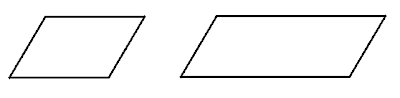
In one class, I was feeling pretty cheeky and I drew this on the board and said, "If you think those are similar, that's like you saying that your face would look the same either here or here."

I think that illustrates non-similarity pretty well (and has a bonus giggle-factor). Afterwards, we used the rubberband parallelograms to practice finding perimeter (Pythagorean Theorem, anyone?) and area (visualization of parallelogram --> rectangle), before launching into a textbook exercise of setting up ratios between similar right triangles to solve for missing sides. Good algebraic practice (involving simplification of square roots, no less), but obviously, this is not what I have in mind for making kids feel EXCITED about trig!
So, I spent part of the afternoon researching options on building inclinometers. The plan is that we'll do one day of flat textbook practice to introduce the basics of trig, then one day "out in the field" measuring tall objects using inclinometers and trig, and then one to two days figuring out where the heck the sine/cosine/tangent values come from, using traditional protractor and ruler. See below. (I can't take credit for this; I'm almost certain I have seen this table format from another teacher at my old school.)


THEN, we'll revisit the Erastothenes video as motivation for inverse trig. (How did Erastothenes find out the angle of the sun relative to the vertical column??)
And, at the end, my kid will (finally, FINALLY) be ready for the Pringles rocket launching goodness. The following blue print is given to me by my awesome physics teacher friend Brian. I haven't built/tested it out yet, but I plan on shooting these more or less straight up to see how high they can go. (Horizontally, I've seen them cover a huge distance, and Brian says that some cannons can send a ball flying for 70 or 80 meters!!)

(And then for my honors kiddies, obviously we'll go into some more advanced stuff, like laws of sine/cosine stuff. I haven't really thought THAT far ahead yet. We'll have to cross the bridge when we get there.)
Thoughts? Suggestions?? Shoot them my way, puh-lease!
We had already discussed right triangle similarity a little bit in our Measurement Unit, when I had taken the kids outside to measure heights of objects using reflections in a pocket mirror. I re-introduced the topic of general similarity this week by asking kids to build congruent and similar parallelograms on the Geoboard. I was more than pleasantly surprised by how DIFFICULT the task was for most of them (honors kids included)!! When I went around and facilitated, I had to guide their attention to slopes of lines, just to get the angles correct in their similar parallelograms. And then, once they had finished constructing (with rubber bands) parallelograms of congruent angles, we discussed as a class why these two are NOT similar:

In one class, I was feeling pretty cheeky and I drew this on the board and said, "If you think those are similar, that's like you saying that your face would look the same either here or here."

I think that illustrates non-similarity pretty well (and has a bonus giggle-factor). Afterwards, we used the rubberband parallelograms to practice finding perimeter (Pythagorean Theorem, anyone?) and area (visualization of parallelogram --> rectangle), before launching into a textbook exercise of setting up ratios between similar right triangles to solve for missing sides. Good algebraic practice (involving simplification of square roots, no less), but obviously, this is not what I have in mind for making kids feel EXCITED about trig!
So, I spent part of the afternoon researching options on building inclinometers. The plan is that we'll do one day of flat textbook practice to introduce the basics of trig, then one day "out in the field" measuring tall objects using inclinometers and trig, and then one to two days figuring out where the heck the sine/cosine/tangent values come from, using traditional protractor and ruler. See below. (I can't take credit for this; I'm almost certain I have seen this table format from another teacher at my old school.)

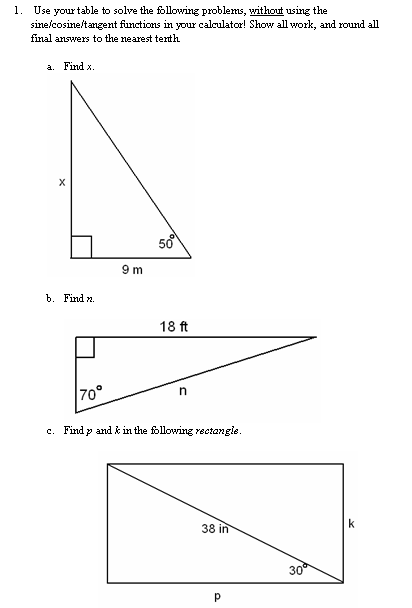

THEN, we'll revisit the Erastothenes video as motivation for inverse trig. (How did Erastothenes find out the angle of the sun relative to the vertical column??)
And, at the end, my kid will (finally, FINALLY) be ready for the Pringles rocket launching goodness. The following blue print is given to me by my awesome physics teacher friend Brian. I haven't built/tested it out yet, but I plan on shooting these more or less straight up to see how high they can go. (Horizontally, I've seen them cover a huge distance, and Brian says that some cannons can send a ball flying for 70 or 80 meters!!)

(And then for my honors kiddies, obviously we'll go into some more advanced stuff, like laws of sine/cosine stuff. I haven't really thought THAT far ahead yet. We'll have to cross the bridge when we get there.)
Thoughts? Suggestions?? Shoot them my way, puh-lease!
Subscribe to:
Posts (Atom)