I'm playing around with the idea of letting kids design and create an animation via parametric equations in GeoGebra. To play around with the idea myself, I tried to come up with some possible motions. Basically, I think that any motion that the kids can dream up, as long as it's a physically sensible pattern, we can create an animation via parametric equation.
Check these examples out: http://www.geogebratube.org/student/mnl0rUuxl . In this, I played around with a bouncing ball, a rotating circle, a rolling wheel, a dampened bouncing ball, and a ball that flies through air with downwards acceleration. In each case, there is an additional rotating point that stays with the circle as it moves around.
If they can dream it, they can create it! My thought is that they would design something, create it in GeoGebra via parametric equations, explain every part of their parametric equation, and plot x(t) and y(t) functions in terms of t (not by hand by via technology), and analyze some critical points along the graph.
Exciiiting!! I love projects like this, because as a baseline, it's reinforcing everyone's understanding of parametric equations, but the upper end is limitless to allow the creative and mathematically confident students to challenge the limits of their knowledge. For example, in order to create the dampened bouncing ball, I had to use the form y1(t) = a/(t + 1)*|sin(bt)| + c just to get the center of the ball to move/bounce in a dampened way, which made the height of the rotating point around the circle more complex:
y2(t) = csin(dt) + a/(t + 1)*|sin(bt)| + c .... In creating even something that looks simple, I incorporated rational, absolute-value, and sine functions. I would be very happy if some of my kids approached this level of complexity in their own projects.
Saturday, March 15, 2014

Thursday, March 13, 2014
Creative Problem-Solving on the Rollercoaster Project
This is going to be a fuzzy-wuzzy post maybe. But, I wanted to write down how much I loved reading through the math work of my Calculus students, who completed those wonderful rollercoasters!
In the end, they took a variety of approaches:
* Some first chose the boundaries x = k, and then wrote down the boundary conditions f'(k) and f(k). They then took a generic form of the next adjacent function g, shifted it over to make g(x-k), and then differentiated g(x-k) and set g'(k - k) = f'(k), and g(k - k) = f(k) to solve for constraints on the remaining parameters in the g equation. In other words, they first chose boundaries, then did transformations, then got the derivatives to match via a standard algebraic approach (which we eventually, at the end of the project, went through as a class in preparation for their quiz).
* Some other students were clever. They first played with functions centered around x = 0, for example f(x) = ax^3, or f(x) = ae^x. They did this because it was easy to manipulate just "a" and the x value to get a numerical derivative and general shape that they wanted. For example, if they wanted a downwards parabola that connects with a derivative of 3, they might first get y = -x^2, and then figure that at x = -1, y' = -2(-1), so y' = 2. So, they figured that if they change "a" to be -1.5, then y' = 3. Bam, they got a general shape and a derivative value to match what they wanted at the boundary. And then all they had to do was to transform
y = -1.5x^2 over and up to the boundary, which is an easy task.
* Some other students chose their boundaries LAST. They first placed the pieces of functions down loosely, then took derivatives of connected equations and set the derivative equations equal f'(x) = g'(x). In their graphing calcs they solved for the x value where this occurs, and used that as the boundary x value. After that, they just shifted the g function up or down to meet the other function in height as well.
* Yet some other students used the principles of turning points to help them connect pieces. They also used horizontal symmetry around a vertex to predict steepness at a future part of a curve, etc.
* Many groups had trouble with ending their rollercoasters with the same height AND derivative value as in the very beginning. To help them make their lives easier, I recommended that they use the vertex form y = a(x - h)^2 + k on both ends, setting k to be the eventual height they wish to reach. They then had to put in an (x, y) value from the other boundary, and solve for a and h as a system. Even in doing this, there were some clever kids who did some clever substitution in order to make it easier to solve a rational system, while other kids turned it into a quadratic-linear system and solved graphically. Loved - it!
I felt really inspired by all of their individuality on this project. Even though it took a few more classes than I would have liked, I felt that the learning -- and moreover, the OWNERSHIP -- made it totally worth it in the end. Yeah!!!
In the end, they took a variety of approaches:
* Some first chose the boundaries x = k, and then wrote down the boundary conditions f'(k) and f(k). They then took a generic form of the next adjacent function g, shifted it over to make g(x-k), and then differentiated g(x-k) and set g'(k - k) = f'(k), and g(k - k) = f(k) to solve for constraints on the remaining parameters in the g equation. In other words, they first chose boundaries, then did transformations, then got the derivatives to match via a standard algebraic approach (which we eventually, at the end of the project, went through as a class in preparation for their quiz).
* Some other students were clever. They first played with functions centered around x = 0, for example f(x) = ax^3, or f(x) = ae^x. They did this because it was easy to manipulate just "a" and the x value to get a numerical derivative and general shape that they wanted. For example, if they wanted a downwards parabola that connects with a derivative of 3, they might first get y = -x^2, and then figure that at x = -1, y' = -2(-1), so y' = 2. So, they figured that if they change "a" to be -1.5, then y' = 3. Bam, they got a general shape and a derivative value to match what they wanted at the boundary. And then all they had to do was to transform
y = -1.5x^2 over and up to the boundary, which is an easy task.
* Some other students chose their boundaries LAST. They first placed the pieces of functions down loosely, then took derivatives of connected equations and set the derivative equations equal f'(x) = g'(x). In their graphing calcs they solved for the x value where this occurs, and used that as the boundary x value. After that, they just shifted the g function up or down to meet the other function in height as well.
* Yet some other students used the principles of turning points to help them connect pieces. They also used horizontal symmetry around a vertex to predict steepness at a future part of a curve, etc.
* Many groups had trouble with ending their rollercoasters with the same height AND derivative value as in the very beginning. To help them make their lives easier, I recommended that they use the vertex form y = a(x - h)^2 + k on both ends, setting k to be the eventual height they wish to reach. They then had to put in an (x, y) value from the other boundary, and solve for a and h as a system. Even in doing this, there were some clever kids who did some clever substitution in order to make it easier to solve a rational system, while other kids turned it into a quadratic-linear system and solved graphically. Loved - it!
I felt really inspired by all of their individuality on this project. Even though it took a few more classes than I would have liked, I felt that the learning -- and moreover, the OWNERSHIP -- made it totally worth it in the end. Yeah!!!
Friday, March 7, 2014
Rollercoaster project SUCCESS!
And (drum rolls), here are all the other rollercoaster projects! They are wonderful!
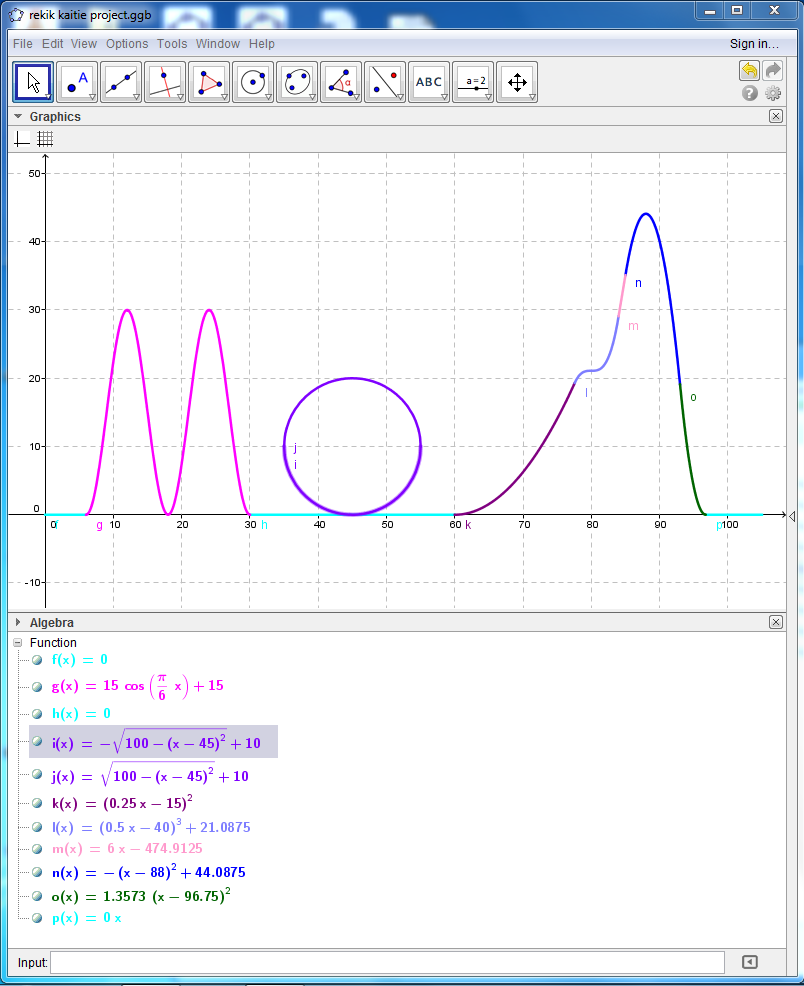
The basic requirements are that they must have 5 segments, and it must be smooth and continuous at all points. The leftmost and rightmost x values must match in their function and derivative values, in order to form a loop!
The basic requirements are that they must have 5 segments, and it must be smooth and continuous at all points. The leftmost and rightmost x values must match in their function and derivative values, in order to form a loop!




Thursday, March 6, 2014
Rollercoaster Sweetness
The first Calculus rollercoaster project file has come in! It looks like this:

Not bad! Let's hope all the other ones will look like this tomorrow. I'll be verrrrry happy. They're also supposed to turn in a 3-D form of this, whereby they draw their curve on poster board, cut it out, and glue the two ends (leftmost x and rightmost x) together to form a sort of loop. That's why their leftmost and rightmost function and derivative values also need to match up. And they need to turn in either calculation work leading up to the equations, or an explanation of how they did it.
Hurray to the end of an era. Next week, we will start another project!
Not bad! Let's hope all the other ones will look like this tomorrow. I'll be verrrrry happy. They're also supposed to turn in a 3-D form of this, whereby they draw their curve on poster board, cut it out, and glue the two ends (leftmost x and rightmost x) together to form a sort of loop. That's why their leftmost and rightmost function and derivative values also need to match up. And they need to turn in either calculation work leading up to the equations, or an explanation of how they did it.
Hurray to the end of an era. Next week, we will start another project!
Thursday, February 27, 2014
Itty-Bitty Update!
Ok, quickie update. If you want more info about anything, you can dig through my current lesson plans here.
1. Life is still busy, but I am finally feeling myself again at work. Despite some rough times behind me, I am feeling pretty good about where my kids stand in terms of their understanding, and that feels motivating. My advisees are also quite successful this year, and even though their teachers' expectations have gone up and up during this year, their grades have still improved steadily. Way to go! I am feeling great about all of this.
2. After a very successful group quiz experience, we are finally doing our first big Calculus project. For some reason, in my head, I had pictured this to be much easier to have the kids create a rollercoaster that is smooth and continuous in all sections and contains a variety of functions. Not so. When I was going through an intermediate example on the board, it was either too easy or too complicated for most kids, and I have had to go around and conference with each group individually to help them achieve their very elaborate plans. After giving them five 45-minute periods and they were still not done, I was feeling quite discouraged. I had to tell them that we were going to stop for a little bit, switch gears to work on integral Calculus, and to come back to the project so that they're not just spinning in place. Fortunately, last time they worked in class (Class meeting #6 on this project, which is just a lot of time), I saw the light at the end of the tunnel. I think after one more class, they'll be able to polish off the rest on their own. Whew. And then we'll be able to move on to our Integral Calculus art project, which is more current and practicing our current algebra skills.
3. In Precalculus, we have been doing lots of trig and it has been just lovely.
a.) The kids had done a Logger Pro exploration of rotating bicycle wheels and a pendulum, and what was even more lovely was the discussion that we were able to have about amplitude, period, and midline based on these real-world examples.
b.) Following that, I got two free cardboard pizza boxes from Domino's and made four circular wheels. The kids played around with showing me places on the unit circle that have the same height ("Estimate where on the unit circle there is a height of 0.7? Where else?") and the same horizontal location ("Estimate where on the unit circle there is a horizontal coordinate of -0.4? Where else?") The tactile display really helped them reinforce their understanding of signs.
c.) They really explored the idea that the graph changes shape (wave vs. circle), when you are graphing time versus X(t), time versus Y(t), or X(t) versus Y(t). Another colleague came to observe this class, and remarked afterwards that the whole time, I never had to write anything on the board! The kids made their own explorations on their worksheets, which is the way things typically go for them.
d.) Without dipping into radians yet, they explored all kinds of transformations to the circle and how that impacts the equation and the shape of its parametric equations.
e.) We played review games with wave equations in degree mode! It was so fun. I let the kids wager points, even though the points didn't count in the end for anything. They - went - nuts.
f.) For learning about radians, I brought in strings for them to estimate how many times the radius fits into a circumference. We talked about what a radian is, and why it's related intimately to the word radius. They then converted degree-mode equations into radian-mode equations simply by using the idea of analyzing units. X(t) = 2cos(20t) + 1 in degree mode means that the point on the circle is traveling 20 degrees/time unit, which means that it is obtained by simplifying (360 degrees)/(length of period). In radian mode, we'll need that number to have the units "radians per time unit", which represents the total circle in radians divided by the length of the period, or (2pi)/(length of period). Easy breezy. Kids understood the reasoning immediately.
4. In Algebra 2, we've finally finished quadratics. Some kids are just breezing through everything, which is just a joy to watch. The others who struggle, boy, do they work hard for me. They're doing okay, earning their way from an F to a B every marking period through sheer valiance and persistence. It keeps me on the edge of my seat to still have them be teeter-tottering through the term, but I love that feeling in the end when they've truly earned their way to a B or even (most recently, two of them got) an A- through endless requizzes and incredible hard work!! So, I feel really good about that!! I love my struggling 10th-graders, and I can only hope that every bit of extra work they do this year is an extra assurance that they'll be able to handle the transition to Precalc next year.
Our next topic is exponential functions. We've already dipped our toes in, and I was pleased to see that they felt comfortable writing linear and exponential equations manually and finding quadratic equations via regression. This is in addition to being able to sketch quadratic systems and analyzing number of expected function intersections via (their joint) discriminant! Hurray to my little algebra troopers!!
That's it for my quick check-in. Hope you guys are doing well and enjoying the SPRING!!!!! OMG, what's this warm golden thing on my skin? I thought that winter would never end this year. Time for weekend bike rides!!!!!
1. Life is still busy, but I am finally feeling myself again at work. Despite some rough times behind me, I am feeling pretty good about where my kids stand in terms of their understanding, and that feels motivating. My advisees are also quite successful this year, and even though their teachers' expectations have gone up and up during this year, their grades have still improved steadily. Way to go! I am feeling great about all of this.
2. After a very successful group quiz experience, we are finally doing our first big Calculus project. For some reason, in my head, I had pictured this to be much easier to have the kids create a rollercoaster that is smooth and continuous in all sections and contains a variety of functions. Not so. When I was going through an intermediate example on the board, it was either too easy or too complicated for most kids, and I have had to go around and conference with each group individually to help them achieve their very elaborate plans. After giving them five 45-minute periods and they were still not done, I was feeling quite discouraged. I had to tell them that we were going to stop for a little bit, switch gears to work on integral Calculus, and to come back to the project so that they're not just spinning in place. Fortunately, last time they worked in class (Class meeting #6 on this project, which is just a lot of time), I saw the light at the end of the tunnel. I think after one more class, they'll be able to polish off the rest on their own. Whew. And then we'll be able to move on to our Integral Calculus art project, which is more current and practicing our current algebra skills.
3. In Precalculus, we have been doing lots of trig and it has been just lovely.
a.) The kids had done a Logger Pro exploration of rotating bicycle wheels and a pendulum, and what was even more lovely was the discussion that we were able to have about amplitude, period, and midline based on these real-world examples.
b.) Following that, I got two free cardboard pizza boxes from Domino's and made four circular wheels. The kids played around with showing me places on the unit circle that have the same height ("Estimate where on the unit circle there is a height of 0.7? Where else?") and the same horizontal location ("Estimate where on the unit circle there is a horizontal coordinate of -0.4? Where else?") The tactile display really helped them reinforce their understanding of signs.
c.) They really explored the idea that the graph changes shape (wave vs. circle), when you are graphing time versus X(t), time versus Y(t), or X(t) versus Y(t). Another colleague came to observe this class, and remarked afterwards that the whole time, I never had to write anything on the board! The kids made their own explorations on their worksheets, which is the way things typically go for them.
d.) Without dipping into radians yet, they explored all kinds of transformations to the circle and how that impacts the equation and the shape of its parametric equations.
e.) We played review games with wave equations in degree mode! It was so fun. I let the kids wager points, even though the points didn't count in the end for anything. They - went - nuts.
f.) For learning about radians, I brought in strings for them to estimate how many times the radius fits into a circumference. We talked about what a radian is, and why it's related intimately to the word radius. They then converted degree-mode equations into radian-mode equations simply by using the idea of analyzing units. X(t) = 2cos(20t) + 1 in degree mode means that the point on the circle is traveling 20 degrees/time unit, which means that it is obtained by simplifying (360 degrees)/(length of period). In radian mode, we'll need that number to have the units "radians per time unit", which represents the total circle in radians divided by the length of the period, or (2pi)/(length of period). Easy breezy. Kids understood the reasoning immediately.
4. In Algebra 2, we've finally finished quadratics. Some kids are just breezing through everything, which is just a joy to watch. The others who struggle, boy, do they work hard for me. They're doing okay, earning their way from an F to a B every marking period through sheer valiance and persistence. It keeps me on the edge of my seat to still have them be teeter-tottering through the term, but I love that feeling in the end when they've truly earned their way to a B or even (most recently, two of them got) an A- through endless requizzes and incredible hard work!! So, I feel really good about that!! I love my struggling 10th-graders, and I can only hope that every bit of extra work they do this year is an extra assurance that they'll be able to handle the transition to Precalc next year.
Our next topic is exponential functions. We've already dipped our toes in, and I was pleased to see that they felt comfortable writing linear and exponential equations manually and finding quadratic equations via regression. This is in addition to being able to sketch quadratic systems and analyzing number of expected function intersections via (their joint) discriminant! Hurray to my little algebra troopers!!
That's it for my quick check-in. Hope you guys are doing well and enjoying the SPRING!!!!! OMG, what's this warm golden thing on my skin? I thought that winter would never end this year. Time for weekend bike rides!!!!!
Friday, January 24, 2014
Rolling Wheel
I am sorry that I have been away. Reasons (not excuses, but I wanted you to know that I didn't mean to just leave a negative-feely post up for a long time and not come back to it):
1. I felt so amazing during December break that I made a new promise to myself to focus on my own wellness this calendar year. I'm exercising a LOT, not to lose weight or anything but just to help me combat physical and emotional stress. I feel great! I am also eating better (at least some salad everyday for lunch, and no seconds in the cafeteria), so generally I feel better than I did in September - December. But, as a result of trying to exercise regularly (I try not to count how many times a week, but it has been more than 3!), I do have less time to do the extra things like blogging...
2. The situation from my last post had a serious update, but it's not really okay for me to write about. It had been very emotional for me, but I'm coming out of the other side now and making peace with what happened, thanks to some amazing people in my (work and personal) life. So, don't worry. I am feeling better and ready to rock the rest of the year.
Anyhow, I looked through my binder recently at work (for current and upcoming lessons that I've polished / made copies of) and noticed that there is almost nothing in there that is recycled from previous years! Surprising, because I have been really consciously trying to work less since the start of January! I am trying a lot of new things, and most of it is working out pretty okay. When I get a chance, I'll sit down and cull through some of the better ideas to share.
I wanted to share quickly my vision of an upcoming project in Precalculus. I want my kids to animate simple things using parametric equations and sine and cosine! Below is an example. It's simple but has some solid math content, I think. In this animated GIF (exported from GeoGebra) the circle is defined by points A and B (hidden), which are both translating slowly as a function of time, t. Point C is also defined using parametric equations, but in this case it is rotating around a moving center, so the kids would have to figure out how that impacts its parametric equations for X(t) and Y(t). I think it would be a fun and visual application of sine, cosine, and parametric equations!
See GeoGebra file here.
Of course, we'll have to scaffold the kids up to this. Let me try to flesh that out. Stay tuned.
1. I felt so amazing during December break that I made a new promise to myself to focus on my own wellness this calendar year. I'm exercising a LOT, not to lose weight or anything but just to help me combat physical and emotional stress. I feel great! I am also eating better (at least some salad everyday for lunch, and no seconds in the cafeteria), so generally I feel better than I did in September - December. But, as a result of trying to exercise regularly (I try not to count how many times a week, but it has been more than 3!), I do have less time to do the extra things like blogging...
2. The situation from my last post had a serious update, but it's not really okay for me to write about. It had been very emotional for me, but I'm coming out of the other side now and making peace with what happened, thanks to some amazing people in my (work and personal) life. So, don't worry. I am feeling better and ready to rock the rest of the year.
Anyhow, I looked through my binder recently at work (for current and upcoming lessons that I've polished / made copies of) and noticed that there is almost nothing in there that is recycled from previous years! Surprising, because I have been really consciously trying to work less since the start of January! I am trying a lot of new things, and most of it is working out pretty okay. When I get a chance, I'll sit down and cull through some of the better ideas to share.
I wanted to share quickly my vision of an upcoming project in Precalculus. I want my kids to animate simple things using parametric equations and sine and cosine! Below is an example. It's simple but has some solid math content, I think. In this animated GIF (exported from GeoGebra) the circle is defined by points A and B (hidden), which are both translating slowly as a function of time, t. Point C is also defined using parametric equations, but in this case it is rotating around a moving center, so the kids would have to figure out how that impacts its parametric equations for X(t) and Y(t). I think it would be a fun and visual application of sine, cosine, and parametric equations!
See GeoGebra file here.
Of course, we'll have to scaffold the kids up to this. Let me try to flesh that out. Stay tuned.
Saturday, December 14, 2013
On Kindness and Conflicts
I have been doing some thinking recently about kindness. In recent years, I am glad to say that I have always opted for being kind, during a conflict when others are scathing towards me. This has happened on several occasions when colleagues or student parents have come at me with misinformation, and because there is no hard evidence in my favor, they choose to interpret things in the worst possible light. Generally, I find that when an opinionated person reaches a conclusion, it is pretty much not helpful at that point of the conflict to try and convince them that they could be wrong. So, instead I have embraced a kindness policy. No matter how personal they try to make their attacks, I keep my end purely professional and courteous. I try to emphasize that we are all on the same side, wanting the best for the kid, and I almost always offer to do something extra to help the situation. (Anyhow I am always doing extra for everyone, so it is not at a cost to me to offer. But, it does make it seem like I am making concessions, which depending on whom you talk to and what their conflict style is, could either be seen as generous or weak.)
The result of this policy is generally good. Last year, one of my colleagues eventually recognized his own fault in the conflict, and although he never outright apologized for his inappropriate and condescending emails insinuating that I was dumb, I knew he came around to being grateful for the way I had handled the conflict, because he started being extra nice to me specifically. He would pull chairs, pour water for me, and even came to chat to me about his newborn for a good thirty minutes. (It was weird because we didn't have a personal connection like that. But because I had already actively let go of the disrespect, it was ok for me to enjoy the civility that had been a product of my choice to be kind.) I have enjoyed similar outcomes with very aggressive parents. One time, one of my students plagiarized part of his work, and during our investigation, we didn't have hard evidence so we let him eventually off the hook after grilling him on content he couldn't really explain. His mom tried to force me to apologize to her son, and was super aggressive and unreasonable. Her son was so embarrassed by her behavior, that he ditched class the next day and told a trusted adult that he couldn't face me after witnessing that conflict. Later, at the next parent meeting, despite me feeling anxious leading up to it, the parent came in ready to apologize. It is crazy, but often kindness begets kindness, and to me it is the only way to approach difficult people.
This year, there are a few students who have, for reasons I cannot fathom, adopted a sarcastic attitude in class that is toxic. People who know me know that I don't have it in me to be sarcastic, and that I am a straight-shooter. I have tried to reach them with kindness, and I don't think it is working. I think the root problem is that the material has really stepped up in difficulty, and as have my expectations for them in terms of homework, writing, working with assigned people, and retaking quizzes. The few kids who are having a hard time either with the topics or with the (actually very modest) workload are reacting not in a self-reflective way, but are shutting themselves off emotionally and intellectually. As I am going over again the calculator skills in class that will help them self-monitor accuracy on the requiz, for example, those few kids are busy snickering in the audience and one kid said, "Oh I just love math, especially this year." Their attitudes are preventing them from making real growth. As I see the other kids ramp up in their abstract reasoning and written accuracy and effort, I see this group potentially falling further behind, if they continue to close themselves off to the possibility of themselves needing to improve. I also see it splitting the class into two groups, those who think class is going fine and are in a way defending me, and those who don't want to contribute to a productive process. (Sarcasm seldom leads to productive discussion or outcome. It is a classic choice of easy cleverness over the harder choice of kindness.)
So, I am going to embrace this situation with as much kindness and firmness as I can balance. I would like to have a frank discussion with my class about this toxic attitude, not only to address it with those kids but also so that their peers can see me model what it is like to embrace a mean-spirited conflict with authenticity and kindness. But, I am going to be cautious about this and to invite another adult into the room (someone I trust and that those kids fear a little), in order to help keep the discussion productive and to not let those kids turn it into an opportunity to be nasty. I don't know if this is going to work. In fact, here is the hardest thing about choosing to be kind: you never do know how people will react to kindness, and it is possible that they will walk away thinking that they've won and not seeing what you are trying to achieve in the long term. But, it feels like the right approach for me, in line with who I am. Wish me luck!
The result of this policy is generally good. Last year, one of my colleagues eventually recognized his own fault in the conflict, and although he never outright apologized for his inappropriate and condescending emails insinuating that I was dumb, I knew he came around to being grateful for the way I had handled the conflict, because he started being extra nice to me specifically. He would pull chairs, pour water for me, and even came to chat to me about his newborn for a good thirty minutes. (It was weird because we didn't have a personal connection like that. But because I had already actively let go of the disrespect, it was ok for me to enjoy the civility that had been a product of my choice to be kind.) I have enjoyed similar outcomes with very aggressive parents. One time, one of my students plagiarized part of his work, and during our investigation, we didn't have hard evidence so we let him eventually off the hook after grilling him on content he couldn't really explain. His mom tried to force me to apologize to her son, and was super aggressive and unreasonable. Her son was so embarrassed by her behavior, that he ditched class the next day and told a trusted adult that he couldn't face me after witnessing that conflict. Later, at the next parent meeting, despite me feeling anxious leading up to it, the parent came in ready to apologize. It is crazy, but often kindness begets kindness, and to me it is the only way to approach difficult people.
This year, there are a few students who have, for reasons I cannot fathom, adopted a sarcastic attitude in class that is toxic. People who know me know that I don't have it in me to be sarcastic, and that I am a straight-shooter. I have tried to reach them with kindness, and I don't think it is working. I think the root problem is that the material has really stepped up in difficulty, and as have my expectations for them in terms of homework, writing, working with assigned people, and retaking quizzes. The few kids who are having a hard time either with the topics or with the (actually very modest) workload are reacting not in a self-reflective way, but are shutting themselves off emotionally and intellectually. As I am going over again the calculator skills in class that will help them self-monitor accuracy on the requiz, for example, those few kids are busy snickering in the audience and one kid said, "Oh I just love math, especially this year." Their attitudes are preventing them from making real growth. As I see the other kids ramp up in their abstract reasoning and written accuracy and effort, I see this group potentially falling further behind, if they continue to close themselves off to the possibility of themselves needing to improve. I also see it splitting the class into two groups, those who think class is going fine and are in a way defending me, and those who don't want to contribute to a productive process. (Sarcasm seldom leads to productive discussion or outcome. It is a classic choice of easy cleverness over the harder choice of kindness.)
So, I am going to embrace this situation with as much kindness and firmness as I can balance. I would like to have a frank discussion with my class about this toxic attitude, not only to address it with those kids but also so that their peers can see me model what it is like to embrace a mean-spirited conflict with authenticity and kindness. But, I am going to be cautious about this and to invite another adult into the room (someone I trust and that those kids fear a little), in order to help keep the discussion productive and to not let those kids turn it into an opportunity to be nasty. I don't know if this is going to work. In fact, here is the hardest thing about choosing to be kind: you never do know how people will react to kindness, and it is possible that they will walk away thinking that they've won and not seeing what you are trying to achieve in the long term. But, it feels like the right approach for me, in line with who I am. Wish me luck!
Subscribe to:
Posts (Atom)