I am learning from a not-great experience with having kids create videos to recap the skills that we had learned during the first semester. I'm jotting it down here so that you can read about how it went and help me to make it better next time.
I still think the idea was good. We had done so much great multi-stepped, contextual algebra practice during the first semester (with my "low" Grade 9 class), that I didn't want them to just leave it all behind as we move on to new Geometry topics in the second semester. I didn't want to have to come back in June to re-teach them everything they knew, but I knew that retention would always be a problem for these kids.
So, I came up with the idea that we'd divvy up all the topics from the first semester, and each group would be responsible to make some explanatory videos on one topic. They'd upload the videos to the web, and I would provide links for all the kids to access these instructional videos. Then, during Spring Break, I'd assign as vacation homework for the kids to watch each other's videos and to do just two or so practice problems related to each video. This way, they're somewhat refreshed on the old concepts over time, and it also takes the pressure off of me as the "all-knowing info source" when it comes to review time.
Sounds good in theory, except I totally underestimated what a huuuuge task this would be for a group of kids who cannot really self-monitor their progress very effectively. They really did try; that I am impressed by. I had helped them prepare for the filming last week prior to leaving for the AGIS Conference, in hopes that they could just use my day of absence to film their videos on the iPads and to upload them. Little did I know that it was not going to be so easy. When I got back this week and looked at the videos, I was pretty disappointed. Most of their videos either had inaccurate mathematics, or the problems they picked were too easy (or, sometimes, too ambitious). I blame that on myself; if you want it to be done right, you simply have to closely supervise the kids in order to give them just-in-time feedback as they are filming and pulling those last pieces together. So, today in class I gave them another 80 minutes to re-do and re-do their mathematics and their videos. This time, I checked in with every group to make sure that their math was production-ready by the time they started filming. Even then, they still had to repeat the filming a bunch of times just to avoid all the careless mistakes. It was just so tough for them to master the simultaneous communication and solving of a multi-stepped problem. In the end, it was really good practice for them to zoom in on their own mistakes and to keep re-doing to correct them, even though the final video quality was not great. (On the iPads, the audio and the video are both of weak quality.) Fortunately, since the kids had mostly selected (with my help) the
topics that they had individually struggled with on the semester test,
this was a great remediation strategy for them to have to create these
explanatory videos, regardless of video quality.
In the future, I really need to think carefully about what technology to use, how to set up the room so that different groups can be filming at the same time, how to help them rehearse prior to filming, etc. There is too big of a range between groups who put in a lot of effort into this project to make a good video, and those who just kind of slapped something together and called it a day. I also need to think about the timing, because unfortunately, this project takes too much time in class, as the kids need support all the way through (including the filming parts) and part of me just wants to move on to new topics already, knowing how much ground we still have to cover.
It's quite a shame that this project didn't work out to have superb products, because I think the process was definitely worthwhile and many of the kids learned a fair amount while doing this. It was definitely challenging for them, and I think some of their frustration came from how challenging this task was. I have hope though, that with some restructuring, I can find a way to make this work much better the next time. One of the restructuring ideas I had, for example, was that instead of everyone doing review videos all at once after a whole semester, after each unit I'd pick a small group of students (who had performed weakly on the exam) to do the videos for just that recent topic. This will ensure that timing is less of an issue, because they'd just work on it outside of class with my help, say at lunch time, and it'd also ensure more immediate remediation. I would also be able to ensure the videos are of better quality, since I am only focusing on managing one group at a time. Have you ever done something like this? Can you share any tips with me to make this a more successful experience in the future?
Addendum: Here are a few samples of produced videos. http://bit.ly/linesReview1, http://bit.ly/linesReview2, http://bit.ly/linesReview3, http://bit.ly/anglesReview1, http://bit.ly/anglesReview2. The kids in my "low" group had to create videos for lines, quadratics, midpoint/distance word problems, drawing geometric diagrams, and analysis of angles. Blip.tv only lets me upload 3 videos each day, so I'll post more links later!
Wednesday, January 30, 2013

Monday, January 28, 2013
Intensive Feedback for Every Kid
I have said this before and I will say it again: I find that mini whiteboards are wonderful in giving immediate feedback to students and receiving immediate feedback from them. This year, after I started using mini-whiteboards on a semi-regular basis in Grade 7, I have seen my students growing leaps and bounds in their accuracy. They absolutely love those lessons because they love to be recognized for being correct. (I usually say after a complicated problem, "Pat yourself on the back if you got that one completely correct." They love patting themselves on the back. heehee. And come on, who doesn't?) By now they're used to the idea that when I say something during the lesson, it is going to help them during the mini-whiteboard practice, so their ears actually perk up to listen. That is night-and-day compared to their attention span on other days.
In one 80-minute lesson last week, we reviewed: multiplying a 2-digit number by a 1-digit number in our heads; finding the common denominator of two fractions like (3x + 5)/24 = (6 - 2x)/7 as an application of this arithmetic skill; cross-multiplication and why it works (this was following DAYS of fractional equations practice, so I felt that at this point they were ready to bypass the denominator part and ready to see why the numerators would change as such); solving various proportional equations using cross-multiplication; solving percent word problems using proportions. In fact, they were so great with this exercise that they were able to figure out that something like (3x - 5)/6 = (2x + 7)/4 would have no solution, which is a topic from a while ago that I just threw in to the mix.
In one lesson, basically all the kids practiced and understood all of these skills. Of course we'll go back to individual/paired practice this week as we build up towards a formal assessment, but having their intensely focused attention for 80 consecutive minutes and receiving/giving constant individual feedback from/to every kid is simply priceless. It does wonders for their progress towards mastery.
In fact, the word has gotten out that I use these mini whiteboards regularly and that I love them... Other-subject teachers on my floor have started to borrow them from me to use in their classes. Great!
...Wow. We're so ready as a class to move on from basic algebra to explore basic geometry. I can actually feel the anticipation! :)
Sunday, January 27, 2013
Gestures, Language, and Student Understanding
I went to a fabulous AGIS session this morning on sign language in the elementary classroom. It was led by Armin Martin and Johnnie Wilson from the Munich International School. They showed videos of kids who use their hands to touch different parts of their heads (front, back, left, right, top, bottom), in order to figure out how many "faces" a cube has. The kids are able to link the mathematical word "face" to layman's definition of "face", in order to bridge the gap between the concepts.
A very interesting point that was made during this presentation was that signs can be used as an intermediary between normal language and academic language, or between home language and school-instruction language. Intentional incorporation of appropriate signs can be a strategy that works not just with our ESL / EAL population but even with our normal kids, and it ties nicely into math because when you gesture in space, you are quickly illustrating and bringing in extra dimensions that are hard to do/experience on paper. The presenters presented research that said that even when you later take away the gestures, the kids still retain the primitive, physical understanding that they had achieved through gesturing. So fascinating, because this discussion/session got me thinking about a lot of different things that previously I had thought to be disconnected:
1. Recently my 7th-graders have been working on percent word problems such as "64 is 40% of what number?" Sure, some kids can easily navigate the proportional reasoning --> 10% of that number must be 16, so 100% of that number must be 160. But, for many kids they need a different strategy, and so we have been practicing setting this up as a proportion. Even then, for kids to read a problem like this and then to consistently set it up correctly, is not trivial. They need to be able to:
a.) Parse the verbal description.
b.) Correctly associate the value given (in this case, 64) with either the fractional percent (in this case, 40%) or the whole (100%).
c.) Set up proportion accordingly.
d.) Solve algebraically.
Of this, part B is the most difficult for 7th-graders. I found this year that when I went around to conference with kids about this process and to help them get started on the assignment, I can just point at the value within the problem (64), and then gesture to them using distance between my hands to ask, "Is this the part or the whole?" This has helped them tremendously, because they can associate the rather multi-stepped numerical operations to a simple visualization, and then they only need to focus on part A (re-reading the question to themselves) in order to make that determination and to carry out the rest of the steps by themselves. This simple gesturing was able to shrink my conference time with each kid to under 1 minute; they immediately would say, "Oh, I get it now," and then proceed with the other questions which were not always phrased in the same way or giving the same information. ("42 is what percent of 70?" "What is 20% of 95?" etc.)
2. When I taught 8th-grade back in New York, I taught one particular 8th-grader who was very economical with his words. I would always put explanation questions on the test, and he was so concise with his explanations that he could always write down the correct answer in about half of the word that I would need to use. This is an incredible skill, because in order to do this, the kid needed to:
a.) Know/master the concept and relevant vocabulary.
b.) Prioritize information in his head.
c.) Formulate his understanding in as few words as possible using the prioritized list.
3. I have read somewhere that babies can already understand physical rules in the world. If you play an optical illusion on them that is against their normal experience, they will keep staring at the place where the ball disappeared after dropping. At this stage, their understanding is far beyond their ability to verbalize it. So, I think it is definitely true that we understand a lot more than our words are able to describe, especially at a young age or as a language-learner.
So, in short, I think gestures are a fabulous way to help kids understand concepts when their language is not yet developed enough to explain or describe a concept (old or new) fully. But, this intentional incorporation of gestures should lead in mathematics to a formalization of those concepts, and attachment of specific language. Because in doing so, we are teaching the value of specificity and prioritization, which are very important skills for the older students to have/develop in the long run.
Hope this little reflection was helpful to you in jogging your brain about how to bridge abstract concepts quickly to visual/kinesthetic understanding for kids. Please share with me if you have had similar success in other examples of utilizing intentional gestures to build intuitive understanding!
AGIS - Day 2; plus, my presentation!
Day 2 of the AGIS conference was great! In the morning, I went to a lovely elementary math presentation done by Beth Winkler from Bonn International School. She is the math subject leader at her school and they do some wonderful investigative things with their kids. She was able to show us various subtraction algorithms, for example, that the kids developed together with the teacher, and to talk about how they structure always two content strands (ie. Numbers and Data/Stats) to run in parallel during any given week. Numbers strand (ie. numeracy and numerical operations) is taught and practiced more or less in isolation (facts are reinforced with games), and the second math strand (such as Data/Statistics) is incorporated into their current PYP themed unit. For example, for the PYP unit "Body Systems," they had kids measure a bunch of their body parts and to do statistical analysis on the results. They also let kids' own curiosities direct them in the direction of mathematical inquiry. Recently, they realized through one such inquiry that the girls' shoes and boys' shoes in the class have the same mean size (length), but the girls' shoes have a smaller range in size than the boys. So, the boys' claim (which was the reason for this mathematical investigation) that "Girls in our class have smaller feet!" isn't really true! How terribly cute and engaging. They also have set periods of math, to ensure that the same amount of math is covered in every grade / class, which can sometimes be a challenge for PYP schools where everything is taught in themes.
Moreover, just the way this lady talked about math was wonderful. She really wanted to focus on helping kids not to be afraid of math, and she understands how to apply concrete-to-abstract continuum in math education, not just within each lesson, but over the years. She made me really wish that our school could have such a subject specialist at the elementary level. It's something I have asked for on behalf of our department, but I don't know if there is such room in our budget to hire such a specialist. Maybe. We will have to see as the 2013-2014 budget slowly takes its shape.
Then came my own presentation! I was very nervous, to be honest. But, the presentation was very well-received by my very small audience (only about 10 people, which is a shame because there were more math people who had wanted to be there, but the session was "maxed out" on paper and so they hadn't signed up...). Everyone came up to me afterwards and said that they thought it was very interesting, even the elementary teachers and one of my own departmental colleagues. They said that they thought there were definitely ideas that they took away that they think they can adapt for their classrooms, which was wonderful because it was my first out-of-school presentation!
Here is the presentation link: http://bit.ly/AGIS2013projs It's meant to be viewed in Slideshow mode, so that you can navigate all the embedded links to slides that make this a presentation that can adjust to audience's interests in real-time. But, in the notes section of the presentation I wrote more verbose descriptions about each slide. During the presentation, I opened one external document (the directions of the 3-D project), to discuss it in details in order to let the teachers see exactly how it would be structured in my class.
Then, after my own presentation I went to a fabulous one on elementary Fun and Games. The teacher is a New Zealander, and she demonstrated various games from New Zealand Math(s) that I thought were very simple in format and easy to adapt to younger or older age groups. She wanted us in the end to brainstorm possible modifications, and I recommended that even skip-counting games like BizBuz can be modified to have students pick algebraic expressions out of a bag, show it to the class, and then say either Biz or Buz depending on whether they are divisible by either of the two expressions specified by the teacher at the start of the game. I am excited to try this game with my Grade 7s when they get to basic algebraic factorization later this year! Another game that I think is very adaptable to the MS classroom is a variation of the spelling game that she administers. Start with kids standing in a circle; one kid says a shape name, such as "Square." Then, the next ____ kids will need to state all the identifying properties of that shape. "Has 4 sides." "Opposite sides are congruent." "All angles are right angles." "All sides are congruent." "Diagonals are congruent." "Diagonals are perpendicular." When all properties have been stated, the last kid says, "Sparkles!" and does sparkly jazz hands (I'll have to see how this works out with my MSers; maybe the sparkles part is too much for them). And the next kid in the circle will get to name a different shape, and this starts over. If the "Sparkles" are prematurely called because there are properties that have been missed, then the kid who called the sparkles would sits down. If a kid says a property incorrectly, then they also sit down. Round-and-round we go to review properties of polygons....
Finally, I went to a talk on tips for school leadership, led by Paul Morris, who is an elementary principal in Stuttgart. Even though the general presentation format was not my favorite, it had some gems of advice. Specifically, these were the things that stood out to me:
- Spend more time with the people who disagree with you / dislike you than the people who like you / support you.
- If you are pushing a new initiative, you need to get a core group of supporters and then just MOVE. It's not possible to wait until everyone gets on board.
- Education fads come and go almost faster than shoe fashion. Get your teachers to help you decide which new trend is a fad, and which is not. Choose carefully.
- Consider carefully the flow of info from meeting to meeting. Design your meeting schedules in a way that pays respect to this need
. - Give parents credit for advocating for their child, even if they may appear misguided to you.
- Admit when you've made a mistake. This models for your teachers how to interact with children and each other.
- Understand that it is very difficult sometimes for international families to adjust to a new situation, and they take it out on the school because that is one thing that they feel they could have control over. Be patient.
- Consult as many people as possible before making a decision. But, don't be afraid to make the decision.
- If someone sends you a one-on-one email, do not write them back. Go find them in person to discuss it. Make opportunities to make face-to-face contact with your colleagues.
- Remember why you are here. Have compassion. Teachers and students are equally important.
- Work from different places. When you get out of your normal working place (ie. office), even if it's just taking your laptop and sitting somewhere else, you gain new perspectives.
Friday, January 25, 2013
TI-84Plus COLOR vs. TI-Nspire; Flexible Grouping
I saw a nifty little presentation today by a TI rep, showing off their latest gadget called TI-84PlusC. To me, it looks like a cross between the TI-83/84 series and the TI-Nspire in terms of functionality. It can import a photo behind the graph for modeling purposes, and it has colored lines and table values. It also allows you to turn on the grid inside the graph, in order to make it easier to estimate points. (These are all features on the TI-Nspire, but this calculator has the same familiar input buttons as the classic TI-83/84s.) The only drawback seems to be that it cannot work with ViewScreen, the piece of hardware that projects the student's calculator work to the wall. It has to do with TI not having enough customer demand for ViewScreen to make it worth it for them to make something that is compatible with the TI-84PlusC. Anyhow, the SmartView still works, and on the new SmartView software for TI-84PlusC, you can tab between the colored calculator view and the plain black-and-white calculator view, in order to support the kids who have different calculators in your class.
The new calculator costs a bit more (maybe 20 Euros more) than the old TI-84Plus, but is comparable in price to the TI-Nspires. I think this might be a viable option for us to order in bulk for our department, instead of TI-Nspires, because from my limited toying around, the TI-Nspires seem to generally require more keystrokes to perform the same function, which -- if true -- would put our kids at a slight disadvantage on timed external assessments like the IB. Anyhow, I am glad that there is an alternative to the TI-Nspire that is a compromise between the "old" and the "new" versions of TI calculators. They're due to be released I believe in March, and in April there will be special teachers' discounts available to bundle the teacher's software (SmartView) free with the calculator order. You can also get a free software upgrade if you already have SmartView currently installed on your computer for the plain TI-84.
-----------
Besides that, I also heard today about a very interesting setup at Munich International School, which has to do with a fluid leveling/grouping program that they implement in the mathematics department. There they have common teaching/planning blocks in the middle school, and they agree in advance of every math unit, what the time frame of that unit will look like and what is the common assessment they will do at the end of the unit. Then, they give all the kids a pre-test and then split them up into ability groups, FOR THAT UNIT ONLY based on their pre-test scores. The kids in the lowest group are supported by an extra teacher. (There are 4 teachers for 3 ability groups, so the 4th teacher is sort of a floater who ends up helping out with the weakest group to allow more intensive attention to be given to those kids. I think this 4th teacher is also a more senior teacher who helps to facilitate with curriculum development.) In the years that they have tried this at their elementary and middle school levels, they have really experienced a lot of success for both the top and bottom kids. The last year (and they project also this year), they were able to extract 2 honors/extended classes going into high school, instead of one. They're essentially taking the best parts of streaming (allowing weaker kids to shine, allowing stronger kids to move along) and taking away the stigma that is associated with being "stuck" in an ability group. They also don't do grouping all the time, and the kids start to be advocates of their own learning, sometimes requesting to move down for a certain topic, in order to focus more on the basic skills. There are only 3 blocks a week when the students meet in these ability groups, and for the other periods they still meet in their homerooms, so they understand that the grouping does not define their identity but merely serves a very specific purpose.
It really sounds fabulous. I think there might be some challenges with implementing it at our school, but we're still excited about bringing it back as a radical idea to discuss. I wanted to pass it along in case some of you might be interested in implementing this at your schools....
----------------
So far, the AGIS conference is going great! If only I wasn't having the allergy attack of my life, it'd be perfect.
Tuesday, January 22, 2013
Pencast as My Substitute
I am going away for a conference on Friday. In order to give my 12th-graders the maximum chance for success, I have tried to create pencasts for all the problems in their packet, so that they can try them (hopefully really try them, OMG senioritis!), and then the substitute will just hit Play to go over the answers.
Like this one.
I am really impressed that PDF has the built in feature to support animations and wav files. wow. Yay to a hopefully still productive day in my absence. Yay to our new Livescribe toy, from which I can see many possibilities for the kids who just need a little more TLC...
Like this one.
I am really impressed that PDF has the built in feature to support animations and wav files. wow. Yay to a hopefully still productive day in my absence. Yay to our new Livescribe toy, from which I can see many possibilities for the kids who just need a little more TLC...
Monday, January 21, 2013
Perpendicular Slopes and Geoboards
I'm delving back into the nitty-gritty linear concepts with my 8th-graders. I came up with an idea of teaching perpendicular slopes using Geoboards. I haven't tried it out yet, but I think it's going to work. They can first try and build a right-side-up square on the Geoboard and draw it in their notebooks on graph paper. Introduce the term perpendicular. When you ask them to draw it on their graph paper, remind them that when we look at shapes and their side lengths, we're counting space units along the side, and not the number of pegs. Then, the plan is to switch it up:
Challenge them now to build a diagonal square in the geoboard. Have them discuss when they think they have found one. Ask them to draw it on their graph paper. And then, once they've found/drawn in their notebooks a bunch of different diagonal square examples, have them look for commonalities. If I now put just one rubberband or segment down to represent one side of the square, can you find out exactly where its perpendicular side needs to extend from/to? What are their slope values? Is there a pattern? Use this to lead in to the idea of reciprocal slopes with opposite signs.

I like this activity idea, because potentially, if it works, you don't have to teach the kids the "negative reciprocal" idea like they are robots. I'll try it this week and then report back. Maybe we'll even have some photos! (I need to keep reminding myself that I need to start accumulating photos of my homeroom kids, for the yearbook.)
And, anyhow, I am excited about my first Geoboard lesson of the year!!! There's nothing quite like handing rubber bands over to 8th graders and expecting them to put them to serious use. :)
Challenge them now to build a diagonal square in the geoboard. Have them discuss when they think they have found one. Ask them to draw it on their graph paper. And then, once they've found/drawn in their notebooks a bunch of different diagonal square examples, have them look for commonalities. If I now put just one rubberband or segment down to represent one side of the square, can you find out exactly where its perpendicular side needs to extend from/to? What are their slope values? Is there a pattern? Use this to lead in to the idea of reciprocal slopes with opposite signs.
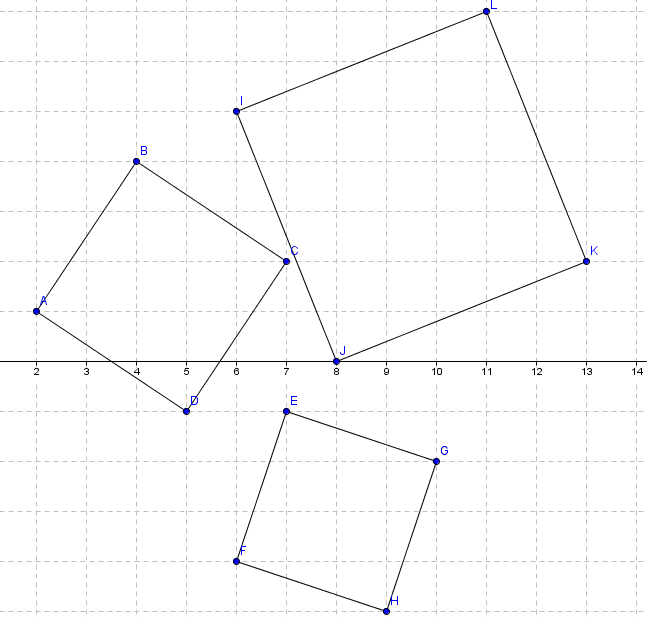
I like this activity idea, because potentially, if it works, you don't have to teach the kids the "negative reciprocal" idea like they are robots. I'll try it this week and then report back. Maybe we'll even have some photos! (I need to keep reminding myself that I need to start accumulating photos of my homeroom kids, for the yearbook.)
And, anyhow, I am excited about my first Geoboard lesson of the year!!! There's nothing quite like handing rubber bands over to 8th graders and expecting them to put them to serious use. :)
Subscribe to:
Posts (Atom)