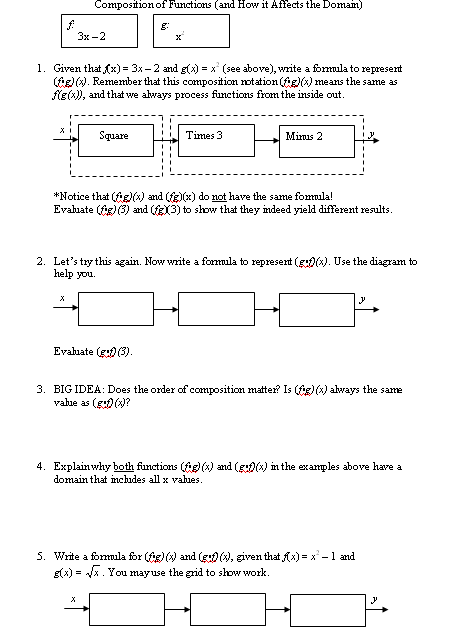
1. why composition functions can combine functions that have different types of domains. (For example, function f takes in dollars as domain, and function g takes in time as domain. It's possible to get an equation that represents f(g(x)). See first problem in Part 2 of the worksheet.)
2. how composition functions combine step-wise dependencies to represent them all in one swoop!
(The examples are a bit silly. But, they are intuitive and easy enough for kids to grasp/follow. After this, I made them do a bit more heavy-duty problems in the textbook, that are less light-hearted and a bit more "real", but also less fun.)
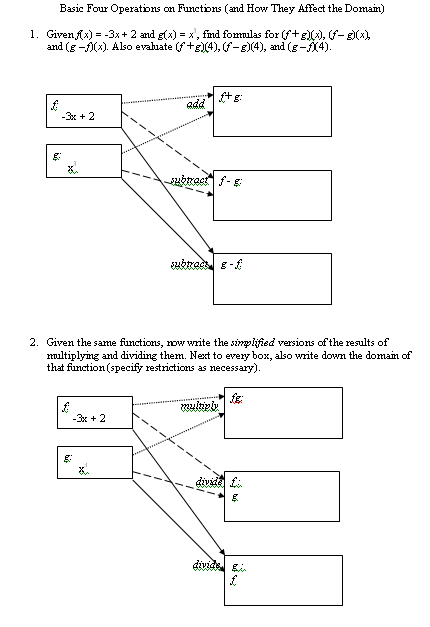
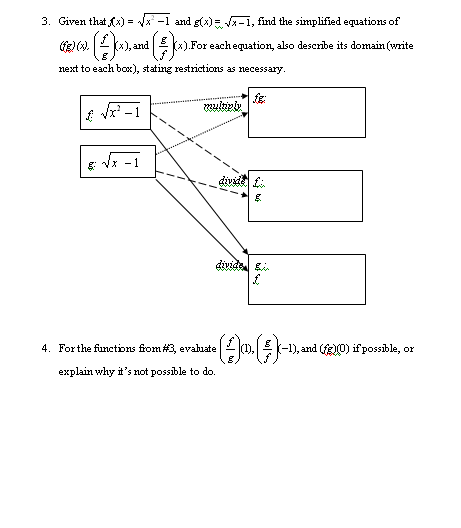
Check them out! (Part 1 is adopted from a lesson from NCTM. I just re-formatted the questions and re-worded them quickly. I was a bit scared by how long it took my 11th-graders to get through that first exercise.) I think the worksheets were pretty effective. I'm sure if you did it with a more accelerated class, they'd breeze right through this, and it'd help solidify their conceptual view of compositions.


--------------------------
I also have an idea for how to teach inverse functions this year using a sort of telephone game. I haven't tried it out yet (that's for tomorrow's class), but I'm thinking of starting the class with writing a table of first / last names on the board and asking kids to evaluate
f(Isabella) or f(Alvaro) for last names. Then, I'll introduce / review that the reverse lookup notation is
f-1(Alvarez) or f-1(Garcia) and that this is called the inverse function.
Then, I'll call a few kids to sit in front of class in a row, and they each will get to pick a secret basic operation +, -, x, with an operand. For example, "+ 3" or "- 8" could be what they secretly choose. I'll give the person on one end of the row a number, and he or she would do the operation in their head, and then tell the result to the next person. So on, until they get to the end. Say that the original number is 10 and the final number is 61, I'd write f(10) = 61 on the board. Then, I'll ask them to go backwards, starting with the last person with the number 61. Each step, they should "un-do" their own step by doing the opposite of what they did before. That way, by the time they get to the front again, we should see that f-1(61) = 10 happened by reversing each operation AND reversing the order of each operation. And I'll use that to introduce how to write equations of inverse functions!
Example: First person secretly chooses "add 3", second person "times 2", third person "minus 9", fourth person chooses to square.
f(x) = (2(x + 3) - 9)^2
That means that on the way back, in order to use the output to find the original input, we would need to: First square root, then "add 9", then "divide by 2", then "subtract 3".
f-1(x) = (sqrt(x) + 9)/2 - 3
I think the nice thing about this demo is that we can repeat this process quickly if kids have questions about any part of the classwork/homework. (I'd just choose kids to represent each step of the operation, and have them sit in a row to demonstrate how the operations reverse their nature as well as their order.)
...I'm excited about this!! I think it will work and make sense to the kids!!! (Of course, I'll also teach them the "short cut" of flipping x and y and solving for the other variable. But I think that comes later, once they have a foundation of what inverse operations are and why they work.)
The other nice thing about the chairs exercise is that we can use it down the road to illustrate why f-1(f(x)) = x, by putting twice as many chairs in a row, with the middle two operations canceling each other out, and then the next pair canceling each other out, etc. Example:
x --> Add 3, Times 4, Minus 1, Plus 1, Divide by 4, Subtract 3 --> you get x back, obviously!
Thoughts??
Addendum: The telephone game worked fabulously! It also was a good anchor for me to come back to in order to explain to kids why inverse function has nothing to do with flipping the signs. All I had to do was say to kids, "When I gave them the reverse input while going backwards, I didn't flip its sign, did I?"
Using the first and last names as warmup also had the added benefit of a giggle factor, when I explained to the class that f(Cuellar) = undefined. (Cuellar is the last name of a very silly and likeable kid in the class, but since it's the wrong type of domain value, it cannot be evaluated. The class thought it was funny that his evaluation gives an error.)