Sunday, January 16, 2011

Letting Kids Develop Their Own Graphical Vocabulary

...Ha! Lots of math posts today/this weekend. I guess you can tell that math is on my mind and that my boyfriend (who is usually the poor victim of my math blabbings) is busy with his own pet projects. :) :)

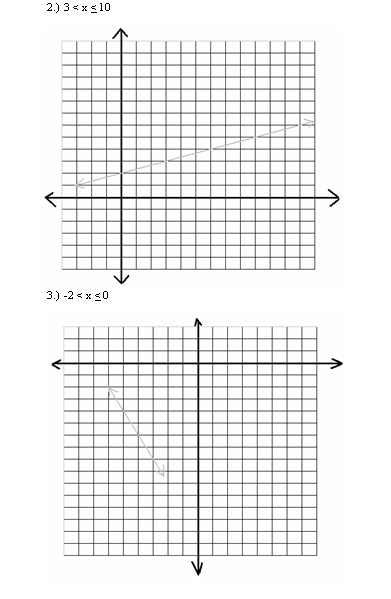
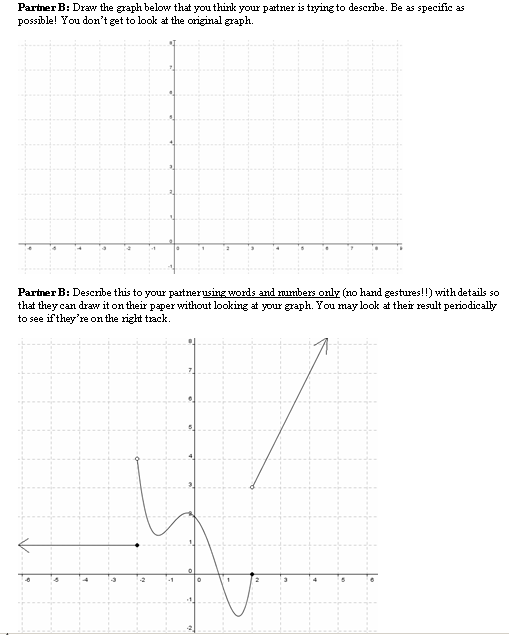
Anyway, I was planning a lesson to teach my precalculus kids some basic graph-analysis vocabulary -- things like concaving upwards/downwards, local minimum/maximum, inflection points. And I wondered: how much of this can the kids come up with on their own? When they are looking at a graph (or forced to look at it closely by describing it to their "blind-folded" friend), how many different features can they pick out without any assistance from me?

I guess we'll find out! This is modeled after a Geometry activity I had done in the past, where kids had to describe transformations in a coordinate plane in their own words before I taught them the proper ways of numerically specifying transformations. Except here, all my juniors will have to do is to get their friends to re-draw the graph without gesturing and without peeking at the original graph! --Easy?


I am interested in whether any group will develop ideas similar to concavity. At the minimum, they should figure out that they're going to need to specify slopes, "highest"/"lowest" points, some type of discussion of curvature, and (hopefully) roots! If they can already pick out all of these distinguishing features on their own, I have every reason to hope that the formal vocabulary will stick without too much trouble.

(Speaking of which, I don't teach middle-schoolers anymore, but it seems like this type of method of developing graphical vocabulary can be extended to middle school, when kids first learn to identify slope and y-intercept. If you give a kid a line and they have to get their friend to re-draw it based on verbal directions only, and they're not allowed to name (x, y) coordinates, what types of things would a kid pick out of the graph to describe??)

Measurement Unit: Episode 4 (Volume Formulas)

It's funny how a little bit of a change to a lesson can make a humongous difference.

Last year (and a couple of years prior), I reviewed volume formulas with my students by putting them into groups and rotating a bunch of prism- or cylinder-shaped containers around. (Largest container was a plastic bucket. Most were tupperware.) They had to measure the objects and to calculate the approximate volume, in cubic centimeters.

This year, I added a new piece. I wanted the kids to be able to visualize that their volume measurements are correct (or incorrect), without me giving them my answers. So, I collected a bunch of liter water bottles and filled them up in advance with water. At the end of the kids measuring/calculating all of the volumes, I said to them that we could certainly verify the volumes with cubic centimeter blocks, but it would require thousands of them per container, and it just doesn't scale. So, instead, we were going to use water. I held up a liter bottle and held up a plastic 10cm-by-10cm-by-10cm container and asked them to vote on which one they thought looked bigger. Once we got outside (Ooh! So warm and sunny!), a kid volunteered to do the demo where they poured the water carefully from the bottle into the cube. Gee whiz! They're exactly the same! To emphasize that this means that a bottle of 1 liter water is equivalent in volume to 1000 cubic centimeters, I showed them using a math manipulative item how you can neatly fit 1000 cm^3 cubes snugly inside the cube container, the same way that 1 liter of water had filled the same container to the brim.

Now that we knew that 1 liter = 1000 cm^3, we started to fill up some of the containers they had measured with liters of water. I kept asking kids what values they had gotten for each container, and volunteers kept pouring in more water to see if it would overflow. (We had some measurement instruments, obviously, to obtain increments smaller than 1 liter.) It was super neat. Every step of the way I kept exclaiming to the kids, "Remember that this means that you're adding in another ______ of those little yellow cubic centimeters!" (Kids were getting secretly competitive, obviously, when other groups' answers were getting eliminated and when the containers turned out to hold about as much as their own answers.)

It was super cool! We collectively marveled in the end at how even a relatively small container can hold a couple of liters of water -- proving that they can fit thousands of those little yellow cm^3 cubes!!

Afterwards, we went back up to the classroom. Our next task was to figure out how we can predict the height of the water inside a new prism-shaped container, once you transfer it from an old container that was filled to the top. I let the groups struggle with this for a while on their own, and most of them figured out one way of doing it (with some guiding questions, mostly). At the board, I had the kids explain their ways of doing it, and we saw that both ways -- finding % of volume taken up in new container, then multiplying it by the total height of the new container; or setting up V = l*w*h with volume of water and solving for h -- arrived at the same answers using very different geometric understanding. I made the kids show me work both ways, using their own measurements/numbers, to verify that they hadn't made an arithmetic error somewhere and that they did indeed understand both methods, and I heard kids say, "Tsssssss..." when they were finished. It's a noise that Salvadoran children make to indicate that something is unexpectedly cool, and that noise made me smile.

And of course, we did the actual experimentation. I filled Container A with water to the top, transfered it over to Container B, and announced to the class that the height rose to about 6cm. Kids got to see for themselves that their calculations brought them to the right ballpark of predictions!

How fun! Now we're ready for big boy conversions!

Saturday, January 15, 2011

Income Tax Unit (Not All Mine!)

Sam Shah had asked, so here it is -- some piecewise lessons I've done in past, leading up to a debate on tax policies at the end of the income tax unit. This course I had only taught once, two years ago, as part of the NYC Math B curriculum. (Or, loosely following the Math B curriculum, I guess.)

Disclaimer: I didn't come up with all of these materials! Some of it I did (all of the extensive scaffolding, more or less, and some word problems). My colleague and friend, Tim Jones, from my previous school had taught the honors version of the same course before me, so I took a lot of the income tax stuff from him. (I had to add a lot of scaffolding for my regular 10th-graders though, and the unit ended up taking twice as long as his class did.)

Link to piecewise unit and link to income tax unit, dumped into viewable directories.

All the lessons are numbered in order (evidence to my organizational tendencies), so they should be easy to follow, but in some cases you'll find that I took two steps forward and one step back, because I had realized that my inherited (honors) version of the lesson was just too-much-too-fast for my kids. Have fun probing! If you have questions or comments, feel free to shoot them my way even though I don't teach much of this stuff anymore.

Piecewise Functions Scaffolding Up the Wahzoo

Out of habit (aka. a compulsive need to organize my work), my lessons are always digitized and numbered sequentially/labeled with keywords, collected into chapter folders and further grouped by classes. At the end of every school year, I zip up the entire folder tree and archive it in multiple places, labeled by year. At the beginning of the school year, I download all of the past archives onto each computer I might be lesson-planning on (one at school and one at home), so that when I need to look up an old lesson, it'd be in front of me in a matter of minutes, complete with handouts and relevant quizzes and tests.

So, anyway, the other day I started to teach my Precalc kiddies the basics of piecewise functions. After the first 1.5 lessons or so (in which I had introduced the mandatory Christmas bonus breakdown in El Salvador and had asked the kids to graph the bonus and to graph a simple progressive tax system*, and also had gone over the basics of evaluating a piecewise function), I thought of digging through my old stuff to pull up some scaffolding material for writing piecewise function equations.

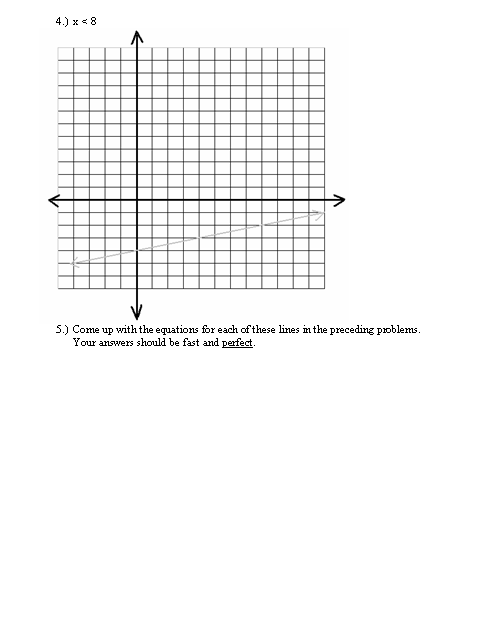
I pulled some of my favorite scaffolding things together into one packet this year. Here it is (I threw a couple of word problems in there for fun, since this packet I intend on grading as a project):


I am posting it because maybe you'd find it helpful to see how I break down piecewise equations into, well, pieces! (If your kids don't need these skills broken down quite so much, you might want to check out Sam Shah's collection of piecewise worksheets, which is a little more comprehensive in the skills they need. Again, I make no claims that my worksheets are comprehensive! They just step in and break it down a little more, like the problems in the textbook don't do...)

*Speaking of which, funny thing about tax systems: I randomly wondered the other day whether there are any countries in the world that actually implement a flat tax. Found this article that talks about how Estonia and two of its neighbors implement the flat tax system, and some of its less-apparent benefits and drawbacks. (For example, did you know that when neighboring countries all implement flat tax systems, it becomes a negative competition sort of thing, where each country may keep lowering their taxes, in hopes of staying competitive?) I shared some of the interesting tidbits with my kiddies, and even they thought it was fun!

And, coincidentally, El Salvador's own tax brackets are exceedingly simple. I am going to give it to the kids sometime next week, as additional practice for making graphs and writing equations.

Friday, January 14, 2011

Using Transformation of Lines to Teach Writing y=mx+b

I am probably super late to the game for thinking about this, but why don't we teach our older kids to write linear equations using the concept of transformation of a graph?? Especially because they seem to have so much trouble remembering to plug in a point to solve for b, and we keep teaching the same method over and over every year.

Here are my Do Now questions for the day (as warm up for writing simple piecewise function equations, which the kids did wonderfully with!). We have seen absolute value equations/transformations this year but haven't covered quadratic transformations yet.
1.) How do the graphs of y = |x| and y = |x - 3| + 5 differ? Be specific.

2.) Try to write the equation of a quadratic function with vertex at (-1, -9) and standard steepness/shape. Simplify your equation as much as possible.

3.) Using the same idea, write an equation of a linear function of slope 8, that passes through (-16, 7). Simplify your equation as much as possible.

4.) All 3 of the above are related concepts. How??

It turned out to be a super nice lead-in to piecewise functions; kids were whipping up linear equations left and right (correctly) and actually focusing in on the domain-restriction aspect of the task. YES! Small victories!!

Thursday, January 13, 2011

Measurement Unit: Episodes 1, 2, 3 (Conversions and Unconventional Measurement Methods)

I have been enjoying the beginnings of the Measurement Unit! I wrote about it briefly back in November, but basically it's an entire unit on conversions and hands-on measurements of various properties of an object.

This is what we did on Day 1 of Measurement Unit (following a mini review of how to do basic conversions):

We were exploring the idea What different types of quantities can you measure?


As usual, even activities as simple as this allows me to catch little gaps in understanding, such as the fact that many 9th-graders need a little nudge in the right direction to figure out how many months old they are. (Most of them just want to multiply their age by 12, and they neglect the fact that their birthday wasn't within the last month!) Also, many of them think that 7 hours and 15 minutes is the same as 7.15 hours. (Naturally, I had seen these issues last year during the same lesson, but had forgotten about them until this week.)

In order to measure their own reaction times, kids followed a fun mini reaction time lab I had found on the interweb (you know, that one where kids drop rulers and their partners need to catch the rulers as quickly as possible). Notice that we're working on estimations as well as actually measuring things and converting things! It made me giggle (and in some cases, made the kids giggle) when they estimated their own reaction times as 1 whole second. I told them that means that when someone punches them in the face, it'd take them 1 whole second to say, "OUCH!"

The kids loved it, as they did last year. Really simple intro to the unit. For homework, they needed to do a sheet of basic conversions:


Then, on Day 2 of the Measurements Unit, I had kids start by brainstorming how we can measure the height of a building! Following that, we talked about setting up ratios using shadows (kids did most of the talking, I just gave them probing hints/questions here and there) until the kids figured out as a class how to find the height of an object using shadows and similarity concept. Then, I explained that it's logistically difficult for us to do a shadows lab, since our period rotates hours each day and it's hard for me to pick items that have clearly visible shadows at all hours of the day. I drew this picture on the board:


And I reminded them that reflected angles are congruent on both sides (like we had seen in the previous mini-golf hole-in-one project) and I asked what lengths they would need to measure, in order to figure out the length of the tree. The kids figured it out collectively. I didn't have to do any talking at all! Brilliant. :)

The rest of the period, we went outside and used their mirrors and metersticks to measure a 3-floor building (~1000 cm tall), a second-floor balcony (~450 cm), and a tree (~300 cm). It was really lovely, and we all enjoyed being outside (especially because, you know, El Salvador is in its warm, dry season)!

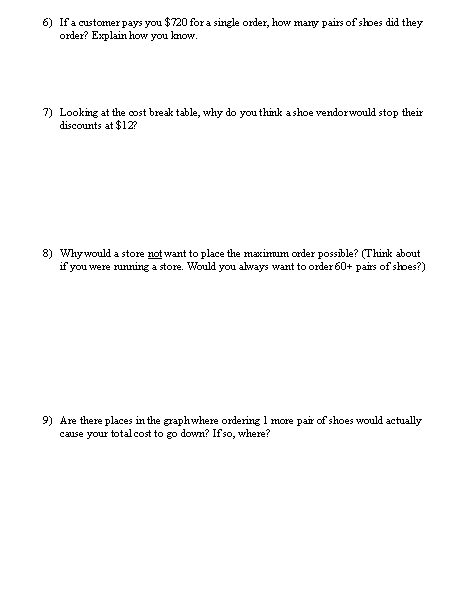
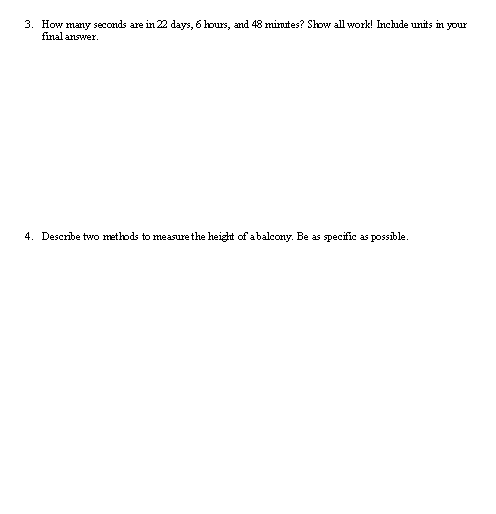
As homework, kiddies needed to do this:


One of the things I had wanted to change for this unit from last year was inserting more practice days in between activity days, so that the quizzes didn't come so much as a shock. So, today (Day 3), I spent half of the class reviewing and giving kids time to work on mixed practice problems, including a recipe conversion problem! It was an idea I got from a physics teacher, who used to make his kids bake in class using cups and teaspoons, but given only metric units. I don't have the connections here to get into the kitchen, but the kids still got into the problem. (It was pretty funny because I had to give them a little background on baking, and how you usually use cups to measure things like flour and sugar and butter, and only use teaspoons for the trace amounts of ingredients.)


After the little mixed practice, I told kids about how last year, I had found myself needing to figure out the exact height of my balcony in preparation for an Algebra 2 Bungee Jump project. I asked the kids how they thought we could measure the balcony besides the mirror/similarity method (which is a little imprecise). One kid in each class had the idea of keeping a string taut between the two floors, and then measuring the string. "Brilliant!" I said. That's what we did the rest of the class: we tied water bottles (as weights) to strings and lowered them to the ground from the second floor. They marked the places on the strings where they thought matched the height of the balcony, pulled the water bottle (weight) back up and measured the string. In the end, the group (in each class) that got the results closest to mine got a few extra points. So there was a friendly little competition, and the kids were super into it!

We talked afterwards about how tape measures is kind of the same idea. Wouldn't it be difficult if you had to measure your waist-line using a straight ruler?

Anyway, I'll write more later. I hope you guys will enjoy hearing about my measurement unit as much as I enjoy teaching it (and the kids enjoy learning it)! We will be going into 3-D measurements next!!!

Monday, January 10, 2011

Things to Consider

There are things I regularly think about, that I know I want. (Sorry if the list sounds very needy. I think we're all entitled to want things, as long as we're willing to put in the work to make them happen!) :)

I want to have my parents know my kids, if and when I have them.
I want to live in the same city, should one of my parents one day be left to live alone.
I want my kids to be able to speak Chinese and to know the stories of our family, fables from our culture.
I want to go back to school.
I want to get back to dancing multiple times a week.
I want to get better at dancing.
I want to learn another language, then another.
I want to be a better teacher tomorrow than today.

I want to work for a school that has PD built into their schedule and their budget.
I want a school that allows me to move around to teach different math classes over time.
I want a school that pays enough for me to travel and to put away money.
I want a school that has small classes.
I want a school where teachers plan collaboratively, where teachers support each other with lesson resources.
I want a school where I can have access to computers, projectors, math manipulatives.
I want a school that offers language classes for teachers.
I want a school whose administrators I feel I can trust.
I want a commute that is under an hour, that doesn't involve driving.

I want an apartment that I can afford, in a neighborhood where I feel safe to walk around at night.
I want to live in a city that has outdoors activities at least part of the time.
I want to live near an international airport.
I want to live in a country where it's (culturally and legally) okay to live together before marriage, where it's encouraged for young people to talk about birth control.


Those are the things that I think about, because I am who I am at this particular point in my life. They help me formulate the questions that I ask when I talk to school administrators, because I know that making an international job decision, in a way, is more complicated than it seems, but in another way cannot be simpler. You need to know exactly what you want out of your job, your home, and your life. And then just really go for it.

PS. Shockingly, it's looking like I might not go to the job fair in London after all! A good opportunity has crept up (from my massive November/December email campaign) that just might turn into a solid offer. If so, then Geoff and I will have to make some quick decisions next week...