I am undertaking an awesome personal endeavor: reading my first Spanish novel! :) I am about 10 chapters (~60 pages) in, and the story is great! I had bought the book at a mall about a year ago, thinking that I would learn Spanish by looking up every word I didn't know (which was pretty much how I had learned English as a kid). But, very soon I realized that, as an adult, I am now much busier and have much less patience for looking up every single word in the dictionary. So, I struggled through about one chapter and gave up promptly. The book had since sat on my shelf, collecting dust.
Randomly, last weekend, on my way out to catch a flight to Austin for my friends' wedding, I grabbed the book since I didn't have any other handy reading material for the plane. I didn't bring a dictionary (it seemed like a hassle), so I tried to read the story using only context clues. Amazingly, it's now entirely do-able for me! Of course, there are still words I don't know, and still some verb tenses that I'm not familiar with, but as a whole, the novel is very enjoyable in all of its banter and irony even though I'm just reading it straight up without a dictionary. --HOW EXCITING!! (A year ago, I had started to write down the list of words I didn't know, that I was encountering in the first chapter of the book. Now looking back at that same list, those words seem really easy, so my Spanish has made a lot of progress! yay.)
Anyway, the book is really good so far; it's a translated American novel called La Loteria, and it's about a man who's mentally handicapped, who lived with his grandma until she passed away. After she passed away, the rest of the family swooped down to divy up her few worldly possessions, but didn't want to take care of him... until he wins the lottery. The really charming part about the book is that he would always state something as it appears, and then state it again in his own blunt understanding of the situation (without all the smoke and mirrors), which is extra cool for me as a language learner, because I get to see the same situation described with and without ill-intentioned euphemisms.
Yesterday, at school, we had a "Drop everything and read!" half-period to celebrate National Reading Day. I told some of my kids that I was slowly reading a Spanish book, and I think they were genuinely impressed! I too often forget that we're supposed to model for our kids that we, too, spend time learning things that are not easy for us. What is it that you do to model that mentality for your kids?
Wednesday, October 27, 2010

Thursday, October 21, 2010
Why I Love Math Teacher Blogs
I did a really fun half-lesson today involving Dan's cup stacking idea, and I really let the kids try to struggle with it for a bit to figure out what they would measure, and how. It worked brilliantly! Especially having come after already several other exercises (see previous posts) where we had discussed the meanings of slope and y-intercept, I really thought that this one tied it all nicely together.
(I didn't use my own height; I picked a kid from each class, which was pretty funny for them, and I got to be the judge of when the stack of cups reached the top of their head.)
We also discussed why it's not as good an idea to measure only one cup, even though you could visually see roughly where the "stacking rim" starts and where the "extra part" ends on that cup. (If you're off by even just 1 mm in measuring the rim, that's really easy to do, but when you account for the fact that you're stacking tens or maybe a hundred cups all together, that margin of error will really add up!) We also discussed again that x is the cause, and y is the effect between the two quantities. In one class, their predictions were right on -- several groups were off by 1 cup only. That's pretty amazing, considering that each additional cup only contributes a couple of centimeters in height.
What a lovely activity!
And, in our precalculus class, we finally did the final testing for the catapult launches. They went really well, and most groups had M&M's that landed right around their targets (using the catapults that they themselves had built earlier)! :) How super cool. There was actually one group whose 3 launches out of 4 had landed right in the (pretty small) landing pad that they had placed on the floor. AWESOME consistency!
I also recycled those M&M's for Kate's estimation activity that introduced absolute values. Now my kids are spoiled because they got to eat M&M's for three days in a row. :)
This is why I love math teacher blogs!!
Tuesday, October 19, 2010
Tilted Parallelogram, Triangles, and Good Ol' Slope
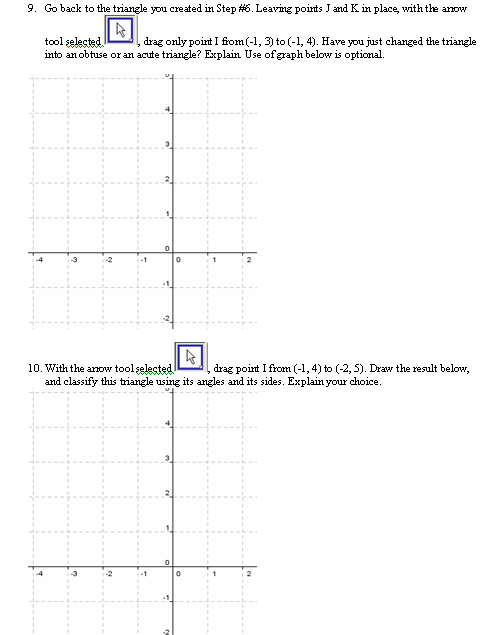
Last year, when I taught parallel and perpendicular lines in Geometry, I took the kids to the computer lab and did some investigation via GeoGebra so that they can observe for themselves that the perpendicular lines indeed have reciprocal slopes, etc. This year, I'll probably do that again with the regular Geometry kids, but with the honors kids (who can already recall from last year how to write parallel and perpendicular slopes), I am skipping over that and giving them a more challenging GeoGebra investigation right away. This new task will ask them to complete parallelograms and tilted right triangles in the coordinate plane, thereby making them apply their knowledge of parallel and perpendicular slopes in order to find the missing vertices. (ie. If you are given three vertices in a parallelogram, where does the fourth vertex have to be? Are there multiple possibilities?) They can use a simple built in polygon tool in GeoGebra to verify that certain sides in their parallelograms (and/or in their isosceles right triangles) are indeed congruent.
Example problems from the activity (slightly rephrased):
I will also give the kids some already-drawn triangles at the end of the investigation, for them to find the slopes in order to determine whether those are acute, obtuse, or actually right triangles. (Because on my last test, some kids drew some triangles that looked sort of like right triangles but were actually not, when you take a closer look at their slopes. I took only a couple of points off then for their "right" triangles, since we hadn't explicitly talked about right triangles in connection with the slopes of their edges. In the future, the kids should be able to catch those mistakes on their own.)
I am excited about this, because it is asking kids to geometrically apply/extend their understanding of slopes, and it also paves the way to coordinate proofs, which are just around the corner.


Example problems from the activity (slightly rephrased):
- If A(1, 1), B(2, -2), C(4, 3) are three vertices inside a parallelogram, where is the fourth vertex, D? (Are there multiple possibilities?)
- If I(-1, 3) and J(0, 1) are two vertices in an isosceles right triangle, where is the third vertex, K? (Are there multiple possibilities?)
- Do the vertices M(-2, 5), J(0, 1), and K(the answer to the previous problem) make an acute, obtuse, or right triangle?
- Do the vertices N(-1, 4), J(0, 1), and K(as before) make an acute, obtuse, or right triangle?
I will also give the kids some already-drawn triangles at the end of the investigation, for them to find the slopes in order to determine whether those are acute, obtuse, or actually right triangles. (Because on my last test, some kids drew some triangles that looked sort of like right triangles but were actually not, when you take a closer look at their slopes. I took only a couple of points off then for their "right" triangles, since we hadn't explicitly talked about right triangles in connection with the slopes of their edges. In the future, the kids should be able to catch those mistakes on their own.)
I am excited about this, because it is asking kids to geometrically apply/extend their understanding of slopes, and it also paves the way to coordinate proofs, which are just around the corner.



Monday, October 18, 2010
Orthocenter Curiosities
I had been reading about orthocenter properties on the web one day when I thought that you might be able to show some of its properties using a tactile activity. I tried it out during my prep period, and it worked as I imagined! Pretty neat.
Here are some pictures, taking you through the steps.
Step 1: Draw a circle.

Step 2: Draw any triangle inscribed inside the circle. (Now is a good time to introduce vocabulary words like "inscribed" and "circumscribed"...)

Step 3: Cut out the circle, and fold it inwards along the edges of the triangle.

Step 4: Mark the point where the three arcs coincide. This is the orthocenter!


Step 5: Verify that your orthocenter is indeed the intersection of the three altitudes by connecting each vertex with the orthocenter, and making sure the result looks perpendicular to the opposite edge.

Step 6: To explain why it works, we label the sides that are congruent with tickmarks!

It doesn't help make orthocenters useful, but it is a fun/easy tactile activity (very 9th-grade appropriate, methinks) that shows visually some of the deeper mathematical properties about orthocenters.
Addendum: Oops - sorry, I was being sloppy with the vocabulary earlier. Can you tell I have circumcenter on my mind? :)
Here are some pictures, taking you through the steps.
Step 1: Draw a circle.

Step 2: Draw any triangle inscribed inside the circle. (Now is a good time to introduce vocabulary words like "inscribed" and "circumscribed"...)

Step 3: Cut out the circle, and fold it inwards along the edges of the triangle.

Step 4: Mark the point where the three arcs coincide. This is the orthocenter!

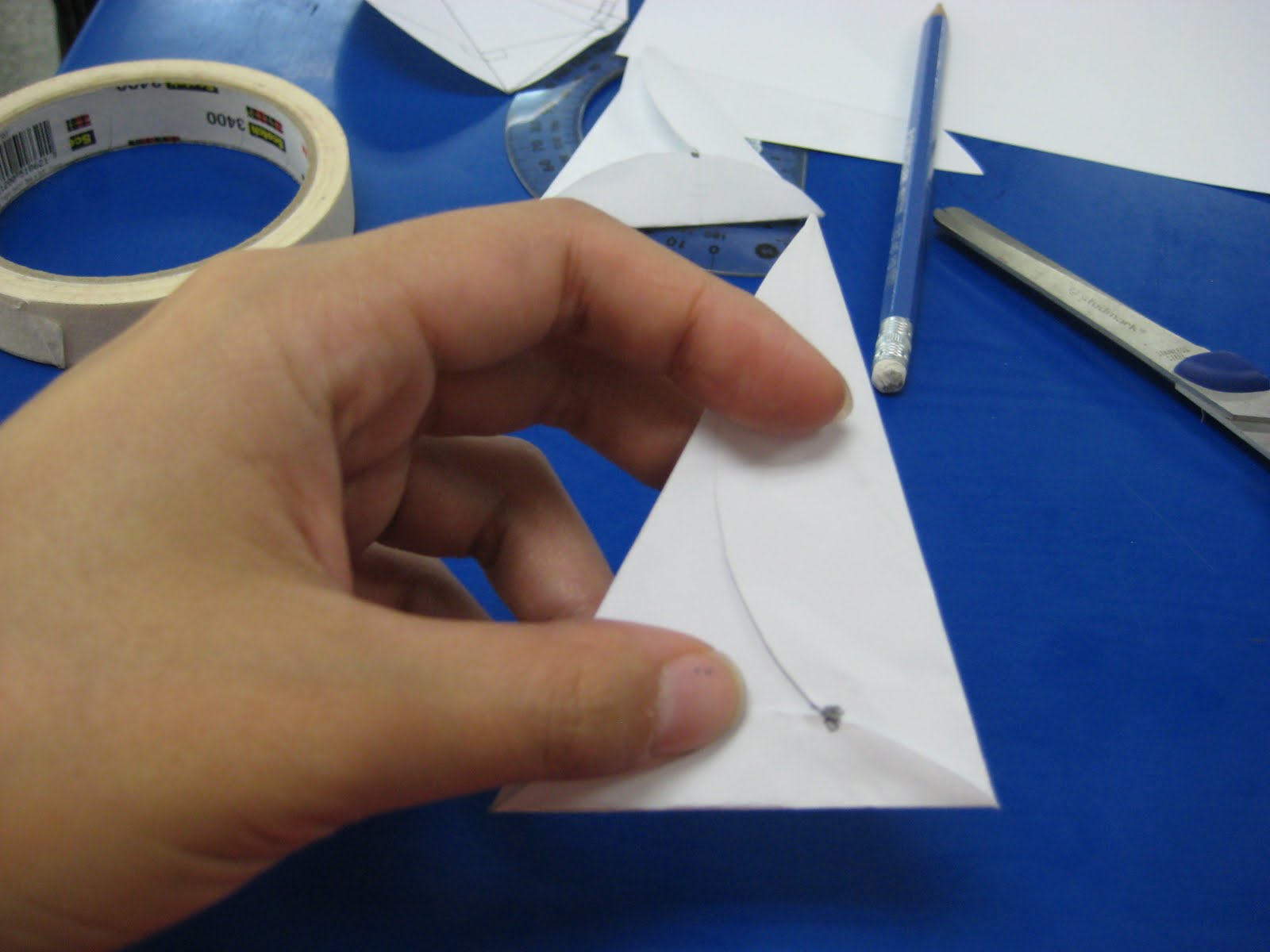
Step 5: Verify that your orthocenter is indeed the intersection of the three altitudes by connecting each vertex with the orthocenter, and making sure the result looks perpendicular to the opposite edge.

Step 6: To explain why it works, we label the sides that are congruent with tickmarks!

It doesn't help make orthocenters useful, but it is a fun/easy tactile activity (very 9th-grade appropriate, methinks) that shows visually some of the deeper mathematical properties about orthocenters.
Addendum: Oops - sorry, I was being sloppy with the vocabulary earlier. Can you tell I have circumcenter on my mind? :)
Sunday, October 17, 2010
Fun in the Sun
THE SUN IS OUT! Has been for two weeks now. It's super lovely; I think we might be finally easing into the dry season. :)
Geoff and I have spent two beautiful weekends in a row at the beach, in good company. Last night, there was a music festival in El Tunco, so we (and apparently everyone we knew) decided to stay at the beach for the night. :) One of the bands was a rock cover band, and played such amazing old hits as "You Gotta Fight for Your Right." It was a great night... I won't divulge many details, but there was some spontaneous Charleston going on, with cheering Salvadorans. I almost had an asthma attack when we got back to our hotel, from trying to keep up with the crazyfast latino drum beats. Good times!!
Next week, we head off to Austin for our friends' beautiful wedding, and after that we will be in Tikal over the first (long) weekend of November! I LOVE this pre-holiday time of the year!! :)
Saturday, October 16, 2010
Activities to Help Kids Understand Meanings of Slope and Y-intercept
I've been introducing linearity to my 9th-graders. I have some introductory linear activities that have always worked very well for me that I'd like to share with you. They work particularly well for regular 8th- and 9th- graders, but you can also adapt them to your struggling students in higher grades.
This first one is a one-day activity, spanning about 60 minutes. Kids go right into it without any teaching, and I only preface it by stating that there are multiple ways of representing changing quantities, and that they would have to reconcile the different representations against each other in order to compare the changing savings amounts throughout the year.


What I like about this first activity is that by the end of it, kids have a pretty intuitive understanding of what slope and y-intercept mean in an equation. They also get a preview of graphical systems of equations and "break-even points", if that is what your curriculum beckons next.
Then, I follow it up with this activity the next day, which again the kids try to do on their own without assistance from me.

For the most part, I observe that kids naturally will want to use either a proportional reasoning or a unit rate to solve the rate comparison problems, which is great! We go over why the unit rate is a direct connection with the idea of slope (once again), and why their process of making the predictions (while taking into account both the rate and the starting value) is very similar to using a linear equation. We also review visual connections with the graphs they made.
At the end, as a quick check in, we do a quick equations Mad Libbs, which takes 5 minutes and reinforces the idea of the meanings of slope and y-intercept. I explain while going over it that slope is "something per something else", and that this is illustrated through some of those Mad Libbs problems.

Again, my pet peeve is that kids often arrive in Algebra 2 without knowing what slope and y-intercept mean in the context of a problem, even if they know how to graph equations and how to write equations. --What is the point of having a bunch of algebraic skills if you don't know what they mean??
As a culmination for my higher-level kids (ie. Algebra 2 or Precalc), I think they should always be able to tell me given a regression equation, what x stands for, what y stands for, what the slope represents, and what the y-intercept represents. It's much harder for kids than you'd think, but I think it's super important for tying everything together.
This first one is a one-day activity, spanning about 60 minutes. Kids go right into it without any teaching, and I only preface it by stating that there are multiple ways of representing changing quantities, and that they would have to reconcile the different representations against each other in order to compare the changing savings amounts throughout the year.


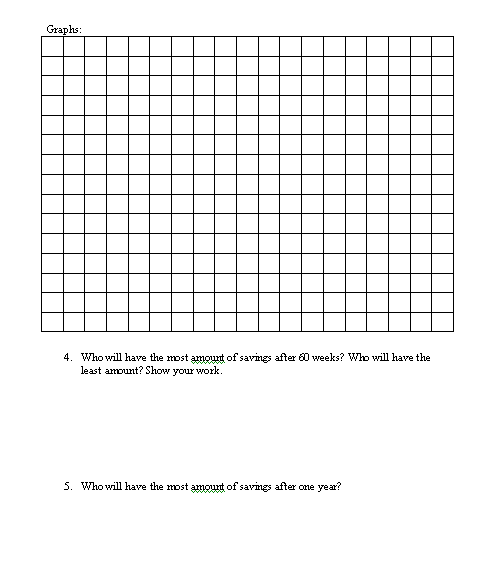

What I like about this first activity is that by the end of it, kids have a pretty intuitive understanding of what slope and y-intercept mean in an equation. They also get a preview of graphical systems of equations and "break-even points", if that is what your curriculum beckons next.
Then, I follow it up with this activity the next day, which again the kids try to do on their own without assistance from me.

For the most part, I observe that kids naturally will want to use either a proportional reasoning or a unit rate to solve the rate comparison problems, which is great! We go over why the unit rate is a direct connection with the idea of slope (once again), and why their process of making the predictions (while taking into account both the rate and the starting value) is very similar to using a linear equation. We also review visual connections with the graphs they made.
At the end, as a quick check in, we do a quick equations Mad Libbs, which takes 5 minutes and reinforces the idea of the meanings of slope and y-intercept. I explain while going over it that slope is "something per something else", and that this is illustrated through some of those Mad Libbs problems.

Again, my pet peeve is that kids often arrive in Algebra 2 without knowing what slope and y-intercept mean in the context of a problem, even if they know how to graph equations and how to write equations. --What is the point of having a bunch of algebraic skills if you don't know what they mean??
As a culmination for my higher-level kids (ie. Algebra 2 or Precalc), I think they should always be able to tell me given a regression equation, what x stands for, what y stands for, what the slope represents, and what the y-intercept represents. It's much harder for kids than you'd think, but I think it's super important for tying everything together.
Friday, October 15, 2010
Try 1 at Re-Test!
I did my first mini-try at a re-test today. The response was overwhelming! I had told my group of regular Geometry kiddies that in order to do the re-test, they needed to bring me test corrections by 4pm the same day I was returning the tests (since the quarter had technically already ended). And even then, they'd only be allowed to re-take one part of the exam that I designate for that kid (in order to make it manageable for me and manageable for them to re-study and to re-focus), and their score for that section would be averaged against their previous score from that same section. Out of my two groups of regular geometry, guess how many kids actually brought me their corrections by 4pm that day? ...16! Wow! I am impressed, freshmen! And this is after I had announced that no one was failing Q1 in my class. Although a handful of those 16 kids failed to show up the next day to take the re-test, I was still pretty happy with the turnout.
(I have to say, this is the first quarter ever where I can say that not a single kid is failing my class, partly because of their own efforts and partly because I was mandatory-tutoring the heck out of them all quarter, starting in Week 2 and all the way through the last week of the quarter. Some kids are still worrisome, but the vast majority is learning at a pretty satisfactory rate.)
But, it also made me glad that I don't do this habitually. I actually forgot to eat lunch today, which I never do. I was so busy all day because of the re-tests and tutoring kids (who aren't mine anymore this year but who still come back to me regularly for math help RIGHT BEFORE their exams), that I realized at 4:30pm that I had forgotten to go pick up our car's registration card (which was at the front office, being processed for a renewal) and that the office was closed and we wouldn't have our registration card over the weekend and THAT'S REALLY BAD...
sigh.
Subscribe to:
Posts (Atom)