Tuesday, August 31, 2010

Geometric Series Fun!

I'm excited about an upcoming lesson about applying geometric series. In fact, I am excited about it enough to be writing about it in way advance. :) (I'm not getting around to it until late next week. But, anyway, it's making me feel very OCD to be pretty much finished with planning for all 3 classes all the way through next week! I am kind of really in love with my job.)

Here it is. I love problem #1, because it brings up the idea of a summation approaching a particular value! If you keep constructing new rectangles at half size (adding counterclockwise each time), you'll see that they just fill in the middle portions and the overall geometric series approachs 2*(original area). YEAH! Chivisimo.


------------------

In other news, Geoff's and my car broke down on the way back from the beach on Sunday. :( --OUR FIRST BREAKDOWN!! The mechanic has been sending us emails with estimated costs, and I just want to know which parts of the car are not broken, because it sounds like he's going to have to replace everything that I either did or did not know existed in a car!! (Fun fact: Our car was spilling oil all over the engine area after having spontaneously broken down on the side of the road, an hour away from our house, when it was already getting dark! It was a bit nerve-wracking, and it even started to rain just as we were waiting on the side of the road. Our friend Greg got out of the car, peeked under the hood, and said seriously, "You guys got a fire extinguisher?" ...Thank goodness we've got awesome friends who live near the beach, who arrived within 15 minutes with a tow truck to drag us all the way back to the city!!)

So, that's gonna be fun... I learned some key words recently from dealing with all the miraculous breakdowns in our lives: grua means tow truck, and calentador is the water heater at our house (whose thermostat broke because of electric current fluctuations that are a side effect of the heavy rains that we had over the summer). Really fun stuff.

Monday, August 30, 2010

Geoboard and Area!

I've been itching to do some neat Geoboard exploration with my Geometry classes, ever since our shipment of math goodies arrived. So, today during my prep period, I randomly pulled together a Geoboard activity for my honors kids to start on during our overflow time. We started it near the end of class, as a change of pace after doing some practice for an upcoming quiz. The kids got through only the first three problems, but it was a really fun / productive time for them! Check it out. I liked it a lot, so I am now thinking about using this activity for my regular kids next week, as warm up before their next big project. The honors kids will probably have some extra time this week to finish off the whole assignment, so I can preview how it would go for my regular classes. :)

(It was fun to observe that kids couldn't immediately build a 5x6 rectangle, because their instinct is to count points/lines instead of # of spaces. Fixing their misconception via adjusting the rubberbands is surely a lot more fun than making them re-draw a shape on a grid!!)


Saturday, August 28, 2010

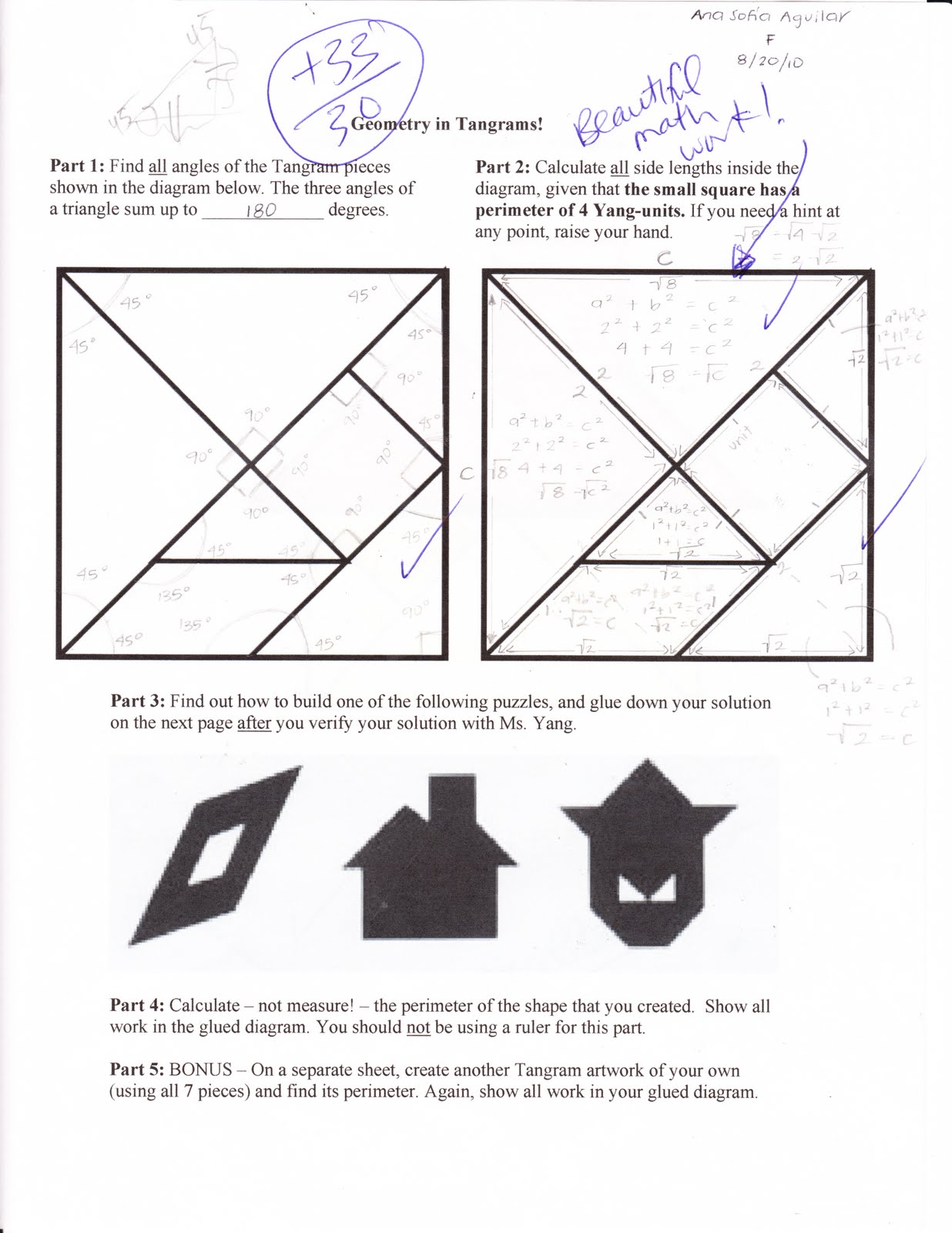
Tangrams Sample Projects

This year, I am going to try to be good about scanning in stuff that my kids have made, so you can see how a project is intended to look / work. :) I love it when other teachers post pictures or videos of what goes on inside the classroom. It makes their lessons seem so much more real!

Here is one. The tangrams project was super fun, for both me and the kids. In the process, we learned how to find angles using adjacent angles in a diagram, how to find angles inside an isosceles angle, how to use Pythagorean Theorem to find diagonal lengths, how to find lengths of sides that "stick out" in a picture, and how to combine / simplify square roots and whole numbers! Wow. So much math in 2 or so days of class time. :) :) And the kids loved the puzzly parts of the project, piecing the tangram pieces together to make the silhouettes. Some kids also took the initiative to create their own designs and to find additional perimeters, which was really fun for me to grade!

Here are the scanned images of a couple of example projects. They look lovely in person, but the math work is in pencil (and some of the colors are also light), so the scanner unfortunately doesn't pick it up all too well. If you zoom in, you can see the math that they wrote next to the diagrams.

Entire project from Kid #1:


Parts of project from Kid #2:

Thursday, August 26, 2010

Lovely Week!

I am having an amazing teaching week. :) Highlights:

  • I started doing MATH origami with my Honors Geometry kids! It's fantastic!! The whole idea is that I would give them diagrammed instructions (with no words on there whatsoever), and they would have to try to figure out how to make the end product by reading the diagrams. On Day 1 of trying this (ie. today), I gave them something that I had thought would be really easy (I had tried it myself and it was relatively easy for me to figure out), and both honors classes were completely stumped (and incredibly engaged)! Yessss. This module is going to be great.

    This first one was supposed to show them how to fold / cut out a regular pentagon out of a square sheet of paper. In the end, after their struggling with it for 15 - 20 minutes and having had varied levels of success / frustration, the bell rang and I announced that we'd have to re-do this particular exercise next week (ie. making pentagons again). The difference is, next time, I'll guide them through reading the diagrams step-by-step (paying careful attention to where the creases are supposed to be and which points should meet up), and we will work on precision as a class. My hopes are that their regular pentagons from next week will be precise enough to allow us to introduce some good geometric vocabulary, and to measure congruent interior angles. :) After that, I have plans for them to make a regular hexagon, followed by a tetrahedron that requires no glue!! (Even other teachers are loving the tetrahedron. I went around Open House yesterday to show off my new origami toy in between parents talking to me, and all the teachers wanted to run off with it! haha. That's how you know it's kid-ready, I guess!)

    By the way, all this good stuff came from 3-D Geometric Origami, which is a super fun booklet of foldable geometric shapes (2-D and 3-D). In doing these constructions, we can introduce naturally a slew of geometric terms about faces, edges, angles, etc. I have plans to get the Honors kids stronger at independently building stuff throughout the first quarter, so that when we move on to heavy-duty compass/ruler constructions of polyhedron nets in the 2nd and 3rd quarters, they'll be kinesthetically (and emotionally) ready.

    (The regular Geometry kids will benefit from the origami lessons as well, but because they will need more time getting through the regular curriculum, I'm not going to give them the serious polyhedron net construction projects later in the year. They'll still do some good compass constructions though, because I plan on doing some simple line designs with all my Geometry classes, and those require the construction of regular polygons.) :)


  • In other news, all of my Geometry kids have been working on setting up algebraic equations with info embedded in geometric diagrams. They seem to be doing better this year with distinguishing the different scenarios for setting up different types of equations. I'm not sure if it's just because it's my 2nd time teaching these exact topics, or what, because I don't feel like my approach has changed drastically from last year, and the kids are having significantly less trouble. There's only been micro-changes, like this year I have emphasized the idea, "Do we have enough info to set up an equation? Do we now? Do we now??" as I put up algebraic lengths piecewise on the board. Does that really make a huge difference in their comprehension??


  • Precalc has been smooth-sailing as well. This week (thus far), we did some good graph-reading, reviewed what a function is, and introduced how to identify its domain and range given a graph. I have a lovely activity for introducing functions, which I didn't come up with but I feel like has been smoothed out over the years every time I present it. Now, it's gotten down to me preparing (in advance) a series of ordered pairs representing a function, and putting them on post-its. (Input goes on one post-it, output goes on another. You stick the two post-its together, front and back.) I draw a "function magic" box on the board with an arrow going in and one coming out, and I start to reveal ordered pairs as I stick the input post-its in and return with the output value on the other side. The reason why I use post-its is simple: as I reveal the ordered pairs, I stick them onto the board in function diagrams (the ones that look like two big ovals, one for domain and one for range), and kids copy them down from the board, one ordered pair at a time. For this intro demo, I always choose some numbers with patterns, so that kids can get excited about making predictions -- and I also use a function that has shapes/symbols as inputs and where the output is consistent, ie. always 5. This way, I can show them that even when one output is shared by different inputs, the function still behaves "predictably" (ie. if it returns 5 always, that's pretty damn predictable) and is still a function. And it also shows them that functions are not limited to numeric domains and ranges.

    After this, I have the kids pair up and I give each pair a set of flash cards, showing functions and non-functions in graphs, tables, diagrams, and word descriptions (ie. "a function that maps age to height"). The pairs of kids have to separate them into two piles, one for function and one for non-function. It's not fancy, but it works really well to quickly go through MANY examples and the kids are really actively engaged. In the end, we quickly go over the answers as a class.

    As for teaching about domain/range of graphs, I totally stole Sam Shah's idea of domain / range meters, and the kids thought it was funny (and probably thought I was "not cool"), but it worked like a charm!! I was thrilled. Kids were beeping (umm, quietly... these kids are waaaay docile...) when they were doing their own classwork problems. heehee


I love teaching! I love the world. Off to Day 2 of Open House (this time, with freshmen parents)!! :) :)

Sunday, August 22, 2010

GeoGebra... times 3!


I made a GeoGebra spirals applet -- for use in my Precalc class! Yay. I'll be introducing geometric and arithmetic sequences sometime during the next week, and even though we'll spend most of that period working on finding numeric trends embedded in composite patterns and such, I think that at the end of class, I am going to use the applet to help them appreciate the connection between nature and geometric sequences. :)

Anyway, that's enough preamble; check it out for yourself! You can make a spiral outwards (if geometricRatio > 1) or inwards (if geometricRatio < 1), and I'll ask the kids to make predictions about what they will see with those ratios before we toggle the numbers. You can also turn on Trace for point B in order to see the actual spirally points.

Amazingly, that's three times in one week that I'll be using GeoGebra. (First time I'll be showing my Geometry kids briefly what Mr. H created per my request, so that they can better visualize why 3 points will define a plane in space. The second time, I'll be taking my Geometry kids down to the computer lab to do a full period of GeoGebra exploration in pairs about Segment Addition Postulate and the midpoint of a segment. See worksheet below if you are interested in seeing just how explicitly I structure an activity like this for 9th-graders who've never seen any geometry software before. If you want the actual file, drop me a note. I did all the way up through step #15 with my 9th-graders from last year and they had all loved it, so I am interested to see if the more challenging parts I tagged on this year will end up "breaking" it. --I guess we will see!)


-------------

Also this week, I'm pulling out an old middle-school activity that I liked a lot, in introducing angles and the estimation of angles. I found out on Friday (during the beginning of our tangrams project) that a handful of my kids didn't know how to recognize right angles in a diagram. Some of the same kids also didn't know that when one angle is 90 degrees (at what looks like a perpendicular intersection), its adjacent angles would also be 90 degrees. ...I have to say, that's pretty alarming. So, umm, we're starting from the basics.

The activity is one that I've done with middle-schoolers many times. You give kids each a piece of patty paper, and you get them to fold it several times and to cut an arc so that when they open it back up, they have a circle that has creases across every 22.5 degrees. Then you just start calling out angles that are multiples of 22.5 degrees, and kids have to figure out (without a protractor) how to use their patty paper to show 90 degrees, 45 degrees, 180 degrees, 135 degrees (at which point, they would have to put it together with someone else's angle), 67.5 degrees, etc. Essentially, the kids learn to estimate angle sizes by comparing them against benchmark angles and thinking about fractions of 90 degrees. (You could also use this manipulative to discuss why when you compare two angles, the sizes of their rays don't matter.)

Let's go, Full Week #2! :)

Saturday, August 21, 2010

Activity of Reading Instructions

I mentioned in the previous post that one of my goals is to encourage my kids to parse instructions and to translate them into mechanical procedures or a diagram. Here is a good (fun) example from Neufeld Math, which Ms. Cookie had linked to; I think I'll use it when I introduce compass constructions. The idea is that I'll let the group struggle with it for 10 or so minutes and not help them out much. (I'll force them to go back to the written directions.) Then, we'll go over the correct results; I'll let a kid present the solution if they are able to parse all the instructions correctly.

In the space provided, draw a circle and then carry out these steps:

  • IMPORTANT: Keep the same radius used to draw the original circle, for this entire exercise.

  • Select a point on the circle’s circumference. Label it A.

  • Center your compass on A. Use the compass to draw an arc that passes through the center of the original circle and intersects the circumference in two places. Label those points B and C.

  • Use the new intersection point C as your center to draw a second arc that passes through the edges and the center of the original circle.

  • Continue around the original circle in clockwise to construct more arcs that pass through the original circle's center and its edges, in order to complete the pattern and to return to point C.

  • Erase all the marks outside of the original circle, leaving only the arcs that are inside. At this point, you should have what looks like a flower with 6 petals inside a circle.

  • Shade in every second region with your pencil.

  • Can you figure out how to construct a regular hexagon that is inscribed in this circle?


What I really like about this activity (besides the rigors of reading and parsing instructions) is that it introduces, in a natural way, some important mathematical terms. Instead of me lecturing on the board, I can simply write or project the pertinent definitions onto the board for the kids to refer to as they delve right into the activity, and I can merely circulate and clarify the math vocabulary (arc, inscribed, circumference, regular hexagon) if they still have questions.

----------------------

Addendum to the graphs powerpoint: a more complicated (and INTERESTING) graph about pay disparity and gender. I always think this issue is so fascinating, because like my friend observed once, we can't really fairly compare the pay between men and women until women begin to periodically re-negotiate their pay the way many of their male counterparts do. I know that I had never re-negogiated my pay while I worked as an engineer, even though at least one of my guy friends did/does it every 6 months. (He actually goes out and interviews with other companies every 6 months to re-assess his market value. Then, he takes their offers back to his HR Department and requests a raise even when it's not annual review time. That's so smart / aggressive.)

Process Goals and Fun with Graphs!

It is timely that I came across this nice post today about goals, because I had been thinking yesterday about listing out some goals on my wall that are not topic-specific, so that I can refer to them throughout the year as I work with my kids on different assignments intended to address one of those life (or processing) skills.

Examples for Geometry:
  • Visualization of parts vs. whole (Isolating info from one part of a diagram; combining info across multiple layers / perspectives.)

  • Mechanical precision (Measuring and constructing lengths within 1 mm error and angles within 1 degree error; building solid models that won't fall apart.)

  • Comprehension of diagrammed instructions (ie. for building anything)

  • Attention to details in written instructions

  • Judgment of reasonableness (of any physical or visual quantity)

  • Effective written and oral communication

  • Perseverence and resourcefulness

  • Team work

Examples for Precalculus:
  • Interpretation of data (Understanding trends / real-world significance / impact.)

  • Fluidity with technology (Using graphing calcs fluently and flexibly.)

  • Flexibility / creativity of problem-solving approaches

  • Risk-taking and reasoning about the unfamiliar

  • Precision and clear step-by-step organization of thought process / math work

  • Increased self-management of progress, frustration level

  • Effective written and oral communication

  • Perseverence and resourcefulness

  • Team work


Maybe it's just me being cheesy, but I think both the students and I might benefit from my posting these goals on the wall -- especially if I do actually highlight different skills throughout the year, as is appropriate to a given lesson, so that the kids would feel like they're not just learning content for content's sake and we are working towards a bigger picture.

My lists of goals are pretty generic (not really even math-specific, for the most part... Most are just good habits of mind...), but they are reminders of what is most important to me. Naturally, between the freshmen (Geometry) and the juniors (Precalculus), there is quite a bit of a "life experiences" gap. So, my goals for the two groups are pretty different as well. My juniors don't need as much for me to hold their hands on following directions, but they might need a nudge to be more creative and/or persevering. Versus the freshmen, whose first task of this year is to learn to consistently read and follow instructions. :) They each are at a different developmental stage with their meta-learning.

We have an opportunity each day to impact kids, mathemagically or otherwise.

-----------------

By the way, I found some nice graphs for my graph-reading lesson that is coming up. They're neat, even though they are not terribly complex in a mathematical sense. (The textbook's got a couple of nice complex graphs to use for rigorous classwork exercises, so I feel like I could afford to spend the rest of the period looking at interesting -- albeit simpler -- graphs with the kids.) They have to do with the mobile market, digital textbooks, and digital music. I plan to have fairly open-ended discussions about trends in those graphs, who might be interested in reading them, and what their implications might be for those people. And then maybe end with why these kids should finish college.* It could end up being a total flop of a lesson hook, but I am curious to see what these juniors can bring to the table.

If I have time, I am also thinking about adopting a middle-school post-it bar graph activity to composite bar graphs and scatter plots. I would give every boy a yellow post-it and every girl a pink post-it, and we would start a bar graph template on the board -- for example, models or brands of cell phones. They would go put their post-its on the board, in the appropriate column, and we would re-arrange the post-its to stack the pink post-its on top of the yellow post-its, in order to create a composite bar graph showing how many boys, girls, and total # of students have each type of phone. You can also do this exercise with scatterplots (for example, height vs. foot length) and see at a glance 1. what the overall trend is within the class, and 2. what the gender-specific trend is within the class. Using only colored post-its! And requiring maybe only about 10 minutes, discussion included. ...I'll try to squeeze it into my Precalc lessons this week and tell you lurkers how it goes.

*From what I hear, many Salvadorean private-school kids end up dropping out of college in the States, because they either lack the academic skills or -- more commonly -- can't deal with the fact that they no longer have a live-in maid and a designated chauffeur. This waste of an opportunity is terribly sad, considering that their parents can afford them to obtain a U.S. college education, while the majority of people in this country are living in poverty and many are starving. :(

But, can you really blame the kids for this injustice?? They are a product of the system (of huge disparity in wealth). sigh.